
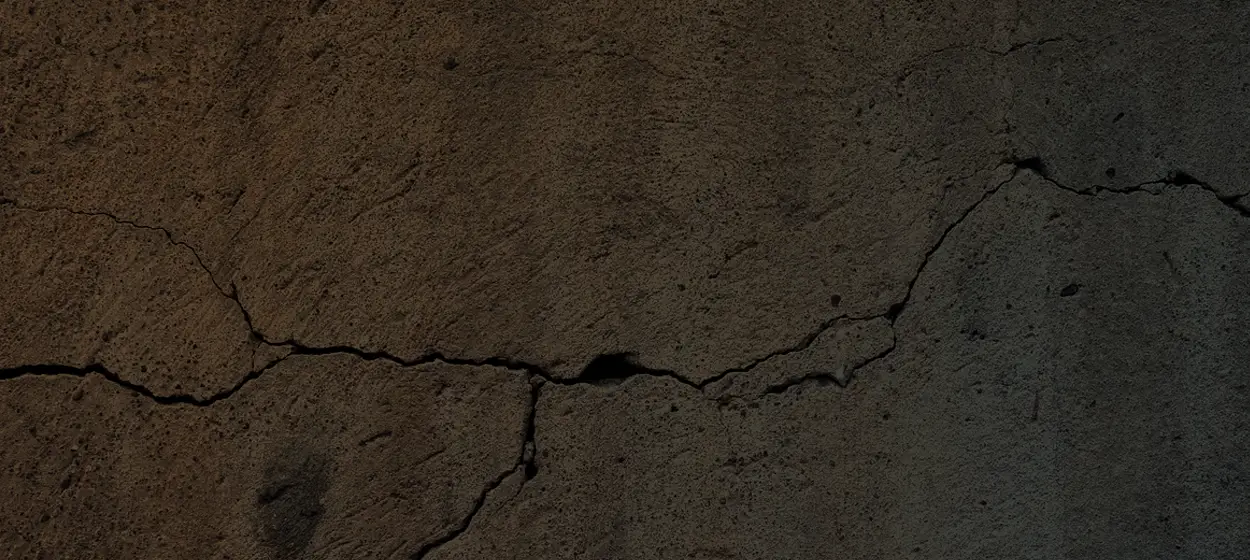
Is your home threatened by cracks?
TerraStab continuously monitors and stabilizes your soil to protect your home from clay shrink-swell subsidence (RGA).
Avoid costly repairs and protect the value of your property.
TerraStab changes the game.
Thanks to a groundbreaking technological approach,
stabilizing a building's soil is no longer limited to heavy construction work.
Our solution opens a new path, accessible, precise and durable.

Technology

Precision

Accessibility

Durability
All the solutions against RGA
There are several ways to fight clay shrink-swell subsidence. Every situation is different. Here's an objective comparison to help you choose.
The most affordable and least invasive.
Smart soil moisture regulation via connected sensors + irrigation stakes. Maintains stable moisture around the foundations, eliminating shrink-swell cycles.
Pros
- The most affordable
- Non-invasive — no major works
- Treats the cause: regulates soil moisture
- Connected: real-time monitoring
- Preventive and curative
Cons
- Not yet deployable on deep foundations
- 3G connectivity required
Invasiveness
Effectiveness
Connected technology, designed to prevent and correct the effects of RGA.
TerraStab installs shallow-anchored probes around the house, connected to a smart irrigation system, itself linked to our servers. Driven by a proprietary algorithm, the system triggers targeted water inputs that keep the clay at a stable moisture level — essential to prevent cracks or stop them from worsening.
Hydro-stabilization is a solution based on unsaturated soil mechanics, an established scientific discipline.
International scientific literature has highlighted the central role of moisture in clay stability. TerraStab draws on this published knowledge to offer a practical application for homeowners.
How does it work?

Connected geotechnical analysis
Satellite data, RGA maps, algorithmic modeling: we assess how the clay behaves on your property.

Hygrometric probe installation
Patented probes, discreet and integrated into the home's surroundings, installed up to 1.20 m deep. No heavy works, no foundation rework.

Smart automated hydro-stabilization
The system adjusts soil moisture in real time, based on measured conditions, to durably stabilize the structure.

Preventive
Prevents the first signs from appearing (cracks, misalignments). Ideal before any damage occurs.

Corrective
Stabilizes homes already affected, limits worsening, avoids heavy and costly works.
Connected geotechnical analysis
Hygrometric probe installation
Smart automated hydro-stabilization
Preventive
Corrective
A project backed by institutions that matter.
TerraStab is supported by public and regional bodies committed to innovation, sustainable housing and climate resilience. This support strengthens our independence, our ambition, and our ability to deploy the solution wherever it's needed.






These partnerships reflect the soundness and viability of the TerraStab project, as well as its potential for positive impact on French housing.
Clay doesn't stabilize itself.
Neither does your home.
Droughts are getting longer, more frequent, and more intense.
This mechanically worsens the shrink-swell phenomenon — year after year.
Stabilizing now means avoiding heavy repairs… and lasting devaluation.


1 in 2 homes
in clay-rich areas affected by 2030


Up to 30%
of property value can be lost


Every year
the risk worsens with climate change
Frequently asked questions
All the answers to the essential questions to understand TerraStab and make the right choice for your home.
Continuous monitoring for optimal effectiveness.
Once installed, your TerraStab system is monitored in real time. You benefit from 24/7 remote monitoring, regular reports on how your land is evolving, and immediate alerts in case of anomaly. Our technical team adjusts the settings to maintain optimal protection all year round.
Clay shrink-swell subsidence news
Analysis, data and advice published by the TerraStab team.
Vendre sa maison fissurée : le RGA, un défi réglementaire et juridique croissant pour l'immobilier
Le retrait-gonflement des argiles (RGA) complexifie la vente des maisons fissurées. Entre nouvelle carte nationale RGA et jurisprudence durcie, les propriétaires sont face à un marché immobilier exigeant.
Patrimoine français : 52% des monuments nationaux menacés par le RGA d'ici 2050
Le patrimoine français fait face à une menace croissante : le retrait-gonflement des argiles. D'ici 2050, plus de la moitié des monuments nationaux seront vulnérables à ce phénomène.
RGA : Un nouvel arrêté CatNat pour 78 communes, le Pas-de-Calais et la Gironde en première ligne
Un nouvel arrêté de reconnaissance de l'état de catastrophe naturelle vient d'être publié. Il concerne 78 communes spécifiquement pour les dommages liés au retrait-gonflement des argiles (RGA), mettant en lumière des départements comme le Pas-de-Calais et la Gironde.
CatNat RGA : L'Assemblée Nationale appelle à des indicateurs météo locaux plus précis
Une question parlementaire souligne l'urgence d'une réforme du régime CatNat RGA. Elle plaide pour l'intégration d'indicateurs météorologiques locaux afin de contribuer à des diagnostics plus fiables et à une meilleure considération des sinistres.
RGA : Quand routes et infrastructures publiques se fissurent, l'impasse du régime CatNat
Le retrait-gonflement des argiles (RGA) ne menace pas seulement les habitations. Les routes, pistes cyclables et réseaux enterrés sont également touchés, provoquant des fissures et déformations significatives.
RGA : Délais de l'assureur, les recours légaux des propriétaires en 2026 face aux fissures
Les délais de traitement des sinistres RGA par les assureurs peuvent être longs et décourageants. Pourtant, des leviers légaux existent pour les propriétaires. Découvrez vos droits et les recours possibles en 2026.
Let's talk about your project
A TerraStab expert reviews your situation and gets back to you within 24h.
Contact us directly
contact@terrastab.fr
Response within 24h — we review every request carefully, even complex cases.
No obligation — free diagnosis, free quote, no sales pressure.