
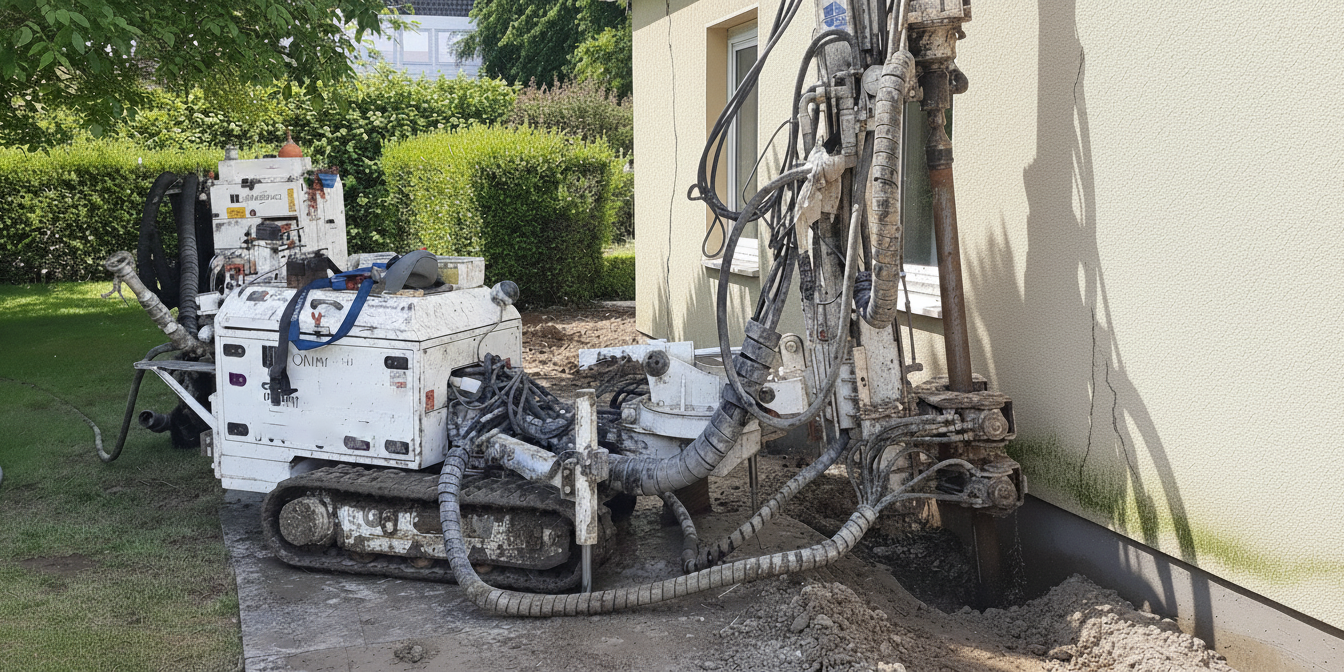
What is a micropile and what is it for?
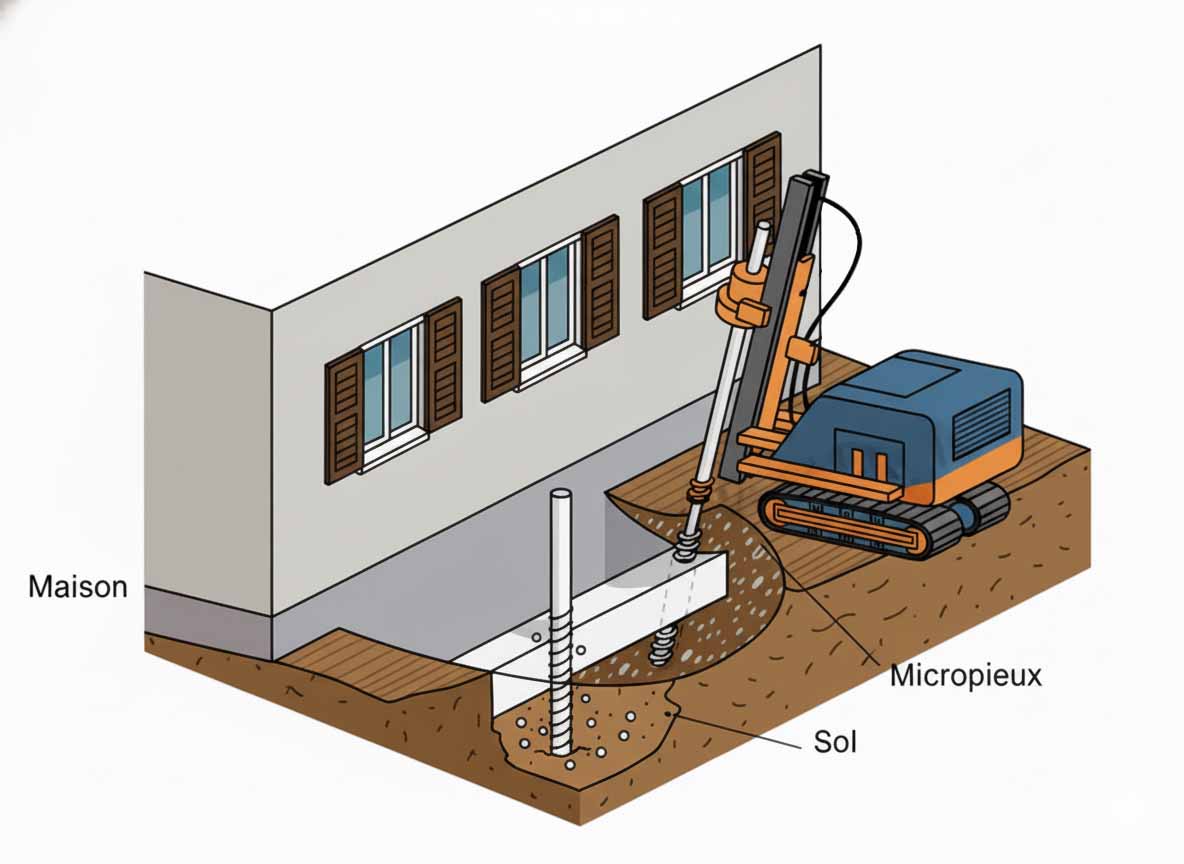
A micropile is a small-diameter deep foundation element (generally 10 to 30 cm) drilled or driven into the soil down to a stable layer, located beyond the zone subject to shrink-swell. It transfers the building's loads to this deep layer, thereby bypassing the movement of the shallow clay soil. Micropiles are used in underpinning to stabilize existing foundations affected by RGA.
From a technical standpoint, micropiles work through two main mechanisms:
- •End bearing: the base of the pile reaches an incompressible layer (rock, compact sand) that directly supports the load
- •Side friction: the surface of the pile mobilizes the surrounding soil's resistance along its entire length
In the context of RGA, micropiles are generally anchored 3 to 8 meters deep, depending on local stratigraphy. At this depth, seasonal water variations no longer affect the soil, ensuring permanent stability.
Micropiles can bear loads ranging from 50 to 300 kN per element, equivalent to several tons. For a single-family home, generally between 10 and 30 micropiles are needed depending on the surface area and the extent of the damage.
Order of magnitude: For a 100 sqm home, the average number of micropiles needed is between 12 and 20, with an anchoring depth of 4 to 6 meters. The total cost of the intervention ranges from €15,000 to €40,000, depending on site accessibility and soil type [2].
When are micropiles necessary?
Micropiles are indicated in several situations: major structural damage with large cracks and significant deformation, ground movement exceeding 4 to 5 cm in amplitude, older buildings with very shallow foundations (less than 40 cm), or highly swelling clay soils in very-high-hazard zones. They are a last-resort solution when preventive or less invasive methods aren't sufficient.
The technical criteria justifying the use of micropiles include:
- Severity of damage: cracks exceeding 5 mm in width, through-cracks, visible subsidence of the ground or floors
- Rapid progression: cracks widening by more than 2 mm per year despite monitoring
- Failure of alternative solutions: drainage, reinforcement, or water regulation insufficient given the amplitude of movement
- Depth of stable soil: when the swelling clay layer exceeds 2 meters thick, traditional shallow foundations cannot be reinforced effectively
- Heritage value of the building: listed buildings, older constructions requiring definitive stabilization
On the other hand, for fine cracks (less than 2 mm) at an early stage, moderate movement (less than 2 cm), or moderately clay-rich soil, less invasive solutions like water regulation may be sufficient and avoid heavy works [3].
Why is this solution often costly?
The high cost of micropiles is explained by the complexity of implementation: deep drilling requiring specialized equipment, underpinning involving cutting and partially lifting the building, skilled labor, and materials (steel, concrete, resin). To these direct costs are added indirect costs: in-depth geotechnical study, impact on occupying the home, and completion times of several weeks.
Cost breakdown
| Expense item | Proportion of total cost | Average amount (100 sqm home) |
|---|---|---|
| G2 AVP geotechnical study | 10-15% | €2,000 - €3,500 |
| Drilling and micropile installation | 50-60% | €10,000 - €24,000 |
| Underpinning (tie-beams, ring beams) | 20-25% | €4,000 - €10,000 |
| Crack repair and finishing | 10-15% | €2,000 - €4,000 |
Several factors drive the cost up:
- •Site accessibility: an enclosed plot or a semi-detached home complicates bringing in drilling equipment, increasing delays and costs
- •Soil type: rocky or very compact soil requires costlier drilling techniques (bentonite mud, temporary casing)
- •Anchoring depth: each additional meter of depth increases the unit cost of the micropile by €50 to €100
- •Building configuration: the presence of a crawl space, basement, or underfloor heating complicates underpinning
Impact on occupancy: Underpinning works generally require partial evacuation of the home for 2 to 4 weeks. This constraint, rarely quantified, represents a significant indirect cost (temporary accommodation, storage, loss of use).
What alternatives exist today?
Faced with the economic and practical limitations of micropiles, several alternatives have developed in recent years: soil water regulation (active water content stabilization), expansive resin injection (filling voids and compacting the soil), screw piles (less invasive than drilled micropiles), and hybrid solutions combining several techniques. These methods aim to reduce costs and disruption while maintaining acceptable effectiveness.
Comparison of the main alternatives
| Solution | Principle | Average cost | Effectiveness | Limitations |
|---|---|---|---|---|
| Drilled micropiles | Deep mechanical anchoring | €15,000 - €50,000 | 95-100% | High cost, heavy works |
| Water regulation | Stabilizing soil moisture | €4,000 - €8,000 | 85-90% | Requires maintenance, needs clay soil |
| Resin injection | Soil compaction and filling | €8,000 - €15,000 | 70-80% | Variable effectiveness by soil, limited durability |
| Screw piles | Screw anchoring (less invasive) | €10,000 - €25,000 | 85-95% | Limited depth, not suited to all soils |
| Reinforced drainage | Evacuating excess water | €3,000 - €6,000 | 40-60% | Preventive only, ineffective during drought |
The choice of solution depends on several factors:
- •Stage of damage: prevention or early cracks → water regulation; advanced damage → micropiles
- •Available budget: under €10,000 → alternatives; over €15,000 → all options
- •Occupancy constraints: occupied home with no possibility of evacuation → water regulation or resin injection
- •Soil type: moderately swelling clay → alternatives suffice; highly swelling clay → micropiles recommended
New approaches from applied geotechnical research, notably water regulation, effectively treat 70 to 75% of RGA-related damage cases at a cost 3 to 5 times lower than micropiles, reserving the latter for the most critical situations.
Focus: Hydro-stabilization vs Micropiles - Technical and economic comparison
TerraStab's hydro-stabilization represents a scientifically validated alternative to micropiles for specific use cases. Here is a detailed comparison to help with the decision:
| Criterion | Hydro-stabilization (TerraStab) | Micropiles |
|---|---|---|
| Principle | Treats the cause: keeps soil moisture stable | Works around the problem: deep anchoring |
| Optimal use case | Medium/high hazard zones, cracks < 3 mm, prevention | All zones, major cracks, severely degraded buildings |
| Effectiveness | 85-90% reduction in movement | 95-100% (definitive stabilization) |
| Installation time | 1-3 days | 2-6 weeks |
| Cost (100 sqm home) | €4,000 - €8,000 | €15,000 - €50,000 |
| Invasiveness | Very low (buried sensors) | High (drilling, structural underpinning) |
| Maintenance | Annual (sensors, irrigation filters) | None |
| Time to effectiveness | Progressive (3-6 months) | Immediate (upon completion of works) |
| Scientific validation | Unsaturated soil mechanics principles | Decades of use, DTU standard |
Guidance recommendations:
- •Choose hydro-stabilization if: early-stage cracks (< 3 mm), shallow foundations, limited budget, desire for a non-invasive solution, medium-to-high hazard zone
- •Choose micropiles if: major cracks (> 5 mm), significant subsidence, severely degraded older building, need for immediate and definitive stabilization
- •Combined approach: localized micropiles (critical corners) + overall hydro-stabilization to optimize cost and effectiveness
In most cases (70-75% according to available studies), hydro-stabilization is enough to stop the progression of damage and prevent it from worsening. Micropiles remain essential for the 25-30% of the most severe cases requiring immediate structural underpinning.
Do micropiles permanently solve the RGA problem?
Micropiles stabilize the building by anchoring it in a deep layer not subject to RGA. They therefore treat the phenomenon's consequences, but not its cause: the shallow clay soil keeps moving. If the foundations are properly underpinned, the building will no longer experience movement. However, secondary damage may persist (slab cracks, ground subsidence around the house) and the soil still requires suitable water management.
In practice, after installing micropiles:
- ✓The building's foundations and structure are permanently stabilized
- ✓Structural cracks stop progressing (after repair)
- ✓The property's value is preserved or restored
- ✗The clay soil around the house keeps moving (ground subsidence, patio or slab cracks)
- ✗Trees and vegetation can still accentuate local water variations
- ✗The cost of the intervention doesn't always include full interior finishing repairs
Additionally, micropiles don't prevent new damage from appearing on extensions or annexes that weren't underpinned. A comprehensive approach including vegetation management, drainage, and possibly complementary water regulation optimizes the durability of the intervention.
Explore modern alternatives
Discover how hydro-stabilization offers a non-invasive, economical solution for most cases.
Frequently asked questions
How much does a micropile cost for a home?
The unit cost of a micropile ranges from €600 to €1,500 depending on anchoring depth, diameter, and soil type. For a 100 sqm single-family home, count on 12 to 20 micropiles, i.e. a material cost of €10,000 to €24,000. Add €5,000 to €15,000 for underpinning and finishing, for a total of €15,000 to €50,000 [2][5].
Do you need a diagnosis before installing them?
Yes, absolutely. A G2 AVP (preliminary design) geotechnical study is essential to correctly size the micropiles: number, anchoring depth, diameter, load-bearing soil type. Without a diagnosis, the risk of undersizing (ineffectiveness) or oversizing (extra cost) is high.
Do micropiles solve the RGA problem?
They stabilize the building by working around the problem, but don't treat the cause (soil water variation). The shallow clay soil keeps moving, which can affect the land, patios, or slabs that weren't underpinned. Complementary soil moisture management remains recommended to avoid new secondary damage.
How long do micropile works take?
Duration varies depending on the number of micropiles, site accessibility and the complexity of underpinning. Count on 2 to 4 weeks for a standard single-family home: 1 week for drilling and installing the micropiles, 1 to 2 weeks for underpinning (tie-beams, ring beams), and a few days for finishing [1].
Do insurers cover micropiles?
Yes, as part of a natural disaster claim (Cat-Nat drought), home insurance may cover micropiles after an expert assessment and applying the deductible. The amount covered depends on the policy, but most insurers accept this solution recognized by inspection bodies. A geotechnical study and detailed quotes are required [6].
In summary
Micropiles are a proven and reliable mechanical solution for stabilizing foundations affected by clay shrink-swell subsidence. Their effectiveness is well established, but their high cost and invasive nature reserve them for critical situations. As knowledge and techniques evolve, less costly and less invasive alternatives, stemming from public research, now offer complementary options to treat the cause rather than simply working around the problem.
References
[1] Micropiles: technical guide. Building technical guides.
[2] Travaux.com (2025). Average costs of underpinning works. Construction price observatory. travaux.com
[3] Alternatives to micropiles for foundation stabilization in RGA zones. Applied geotechnical studies, 2021. georisques.gouv.fr
[4] Risk and land use planning: clay shrink-swell subsidence. Official Géorisques documentation, 2020. georisques.gouv.fr
[5] AQC – Agence Qualité Construction (2015). Cracks caused by clay shrink-swell. qualiteconstruction.com
[6] France Assureurs. Understanding expert assessment for clay shrink-swell claims. Practical Cat-Nat guide. franceassureurs.fr