
What simple actions protect a home?
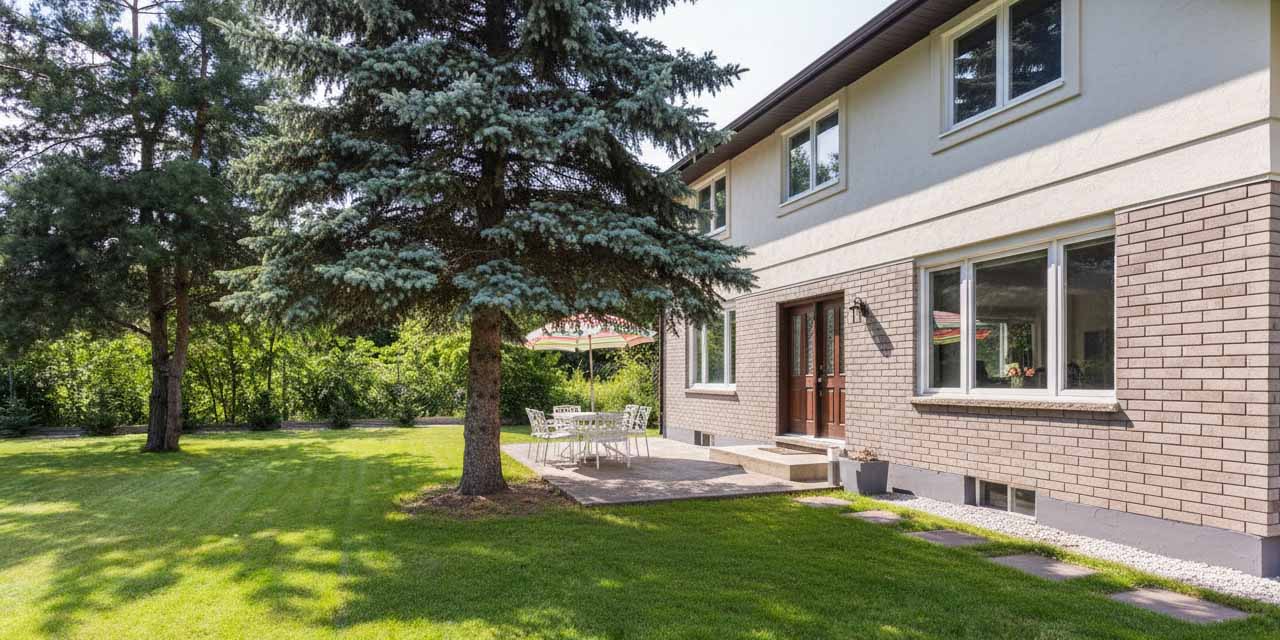
Several simple and regular actions help protect a home on clay soil: maintaining moderate, even watering around the house during dry periods, cleaning and checking gutters and drains, avoiding planting large trees within 5 meters of the foundations, monitoring the appearance or progression of cracks, and avoiding abrupt changes to the water environment.
✅ Do
- •Clean gutters and drains twice a year
- •Install a perimeter drain if the land slopes
- •Plant shrubs with moderate root systems
- •Monitor cracks with plaster tell-tales
- •Maintain a safety distance (≥ 5 m) between trees and foundations
- •Ventilate the crawl space if present
❌ Don't
- •Plant large trees (oak, poplar, willow) near the house
- •Let water stagnate against the walls (bad slope, clogged gutters)
- •Waterproof the entire perimeter (prevents natural infiltration)
- •Water irregularly or too abruptly
- •Cut down a large old tree without prior consultation
- •Ignore progressing cracks
- •Leave water leaks unrepaired
Automated hydro-stabilization: next-generation prevention
Beyond manual watering, automated hydro-stabilization systems enable optimized RGA prevention. TerraStab represents this next-generation approach:
- •Continuous monitoring: buried sensors measuring soil moisture and temperature 24/7, detecting drift before it causes damage
- •Predictive anticipation: algorithms predicting shrinkage periods 7-15 days in advance by cross-referencing field and weather data
- •Automatic regulation: subsurface irrigation activated only when needed, keeping the soil within an optimal variation range (±3%)
- •Remote monitoring: mobile app to view soil status and intervention history
This approach combines passive prevention (manual vegetation and drainage management) with active prevention (automated water regulation). It is particularly aimed at homeowners in medium-to-high hazard zones wanting maximum protection without constant monitoring.
Cost and benefits: A hydro-stabilization system represents an accessible investment — well below curative underpinning (micropiles, resins) — with minimal annual maintenance. Over 10 years, the preventive investment represents a fraction of the cost of a heavy structural intervention.
Do trees or patios worsen the risk?
Yes, under certain conditions. Trees with extensive root systems (oak, poplar, willow, ash) draw water from the soil during dry periods, increasing clay shrinkage within up to 1.5 times their height. Waterproof patios, if poorly designed, can concentrate runoff water or, conversely, dry out the soil through shade effects. Suitable management (planting distance, species choice, drainage under the patio) minimizes these effects.
Vegetation and RGA: safety distances
DTU 13.1 recommendations (shallow foundation standard) set minimum distances between vegetation and foundations:
| Vegetation type | Mature height | Recommended minimum distance |
|---|---|---|
| Shrubs (lavender, boxwood, roses) | < 2 m | 1 m |
| Small trees (cherry, apple) | 3-5 m | 3-5 m |
| Medium trees (birch, maple) | 8-12 m | 8-12 m |
| Large trees (oak, poplar, plane tree) | > 15 m | 15-20 m |
| Evergreen hedges (thuja, cypress) | Variable | 2-3 m minimum |
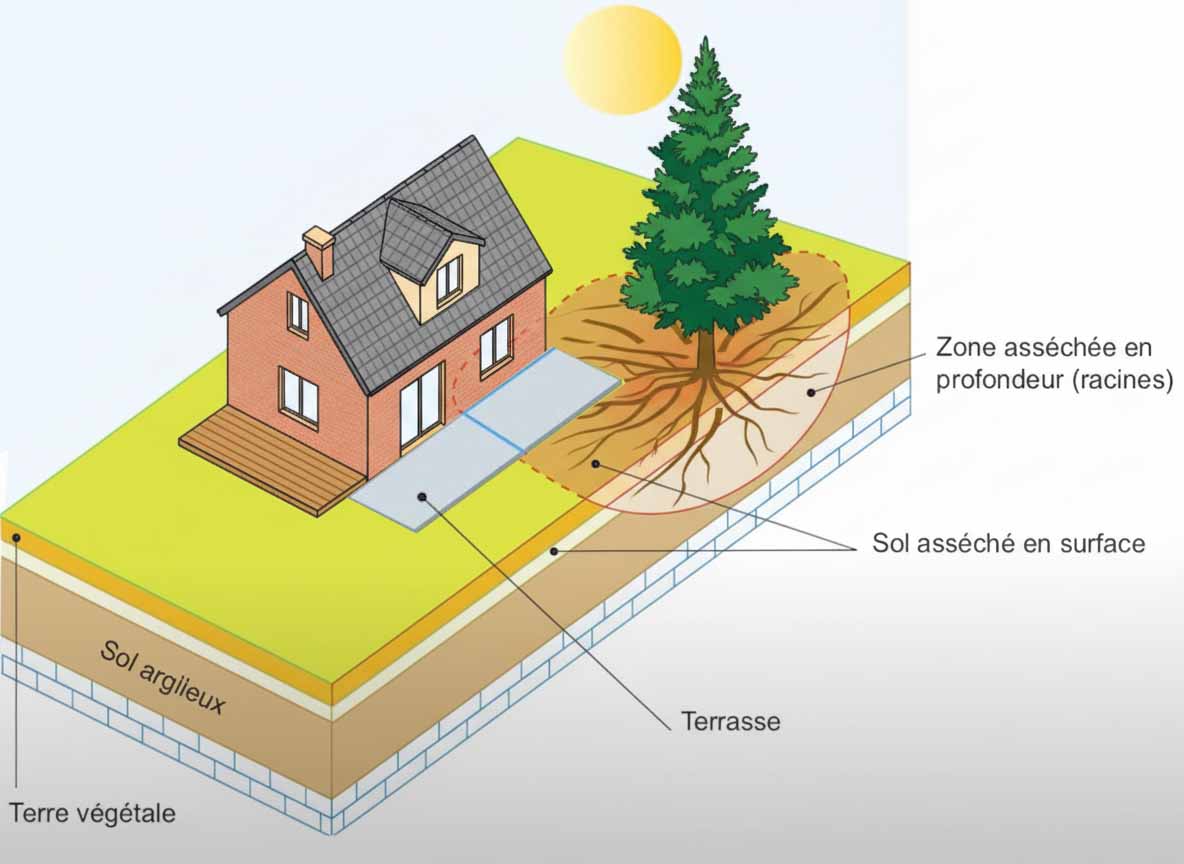
In practice, the radius of root action depends on the species, the age of the tree, and water availability. A 20-meter-tall oak can draw water from up to 30 meters away during a prolonged drought.
Special case – Removing old trees: Removing a large tree that was drawing a lot of water can cause a sudden soil swelling (a "hydric rebound" phenomenon). It is recommended to consult a geotechnical engineer before cutting down a tree over 10 years old located within 15 meters of a home in a clay area.
Patios and outdoor landscaping
Patios can influence the soil's water behavior in two ways:
- •Water concentration: a poorly drained patio or one with a reversed slope can direct rainwater toward the foundations, causing localized swelling
- •Drying through shade: a large patio prevents rain from reaching the soil, contributing to drying
To limit these effects:
- •Provide a slope of at least 1.5% to drain water away from the foundations
- •Install a perimeter drain around the patio if the soil is poorly permeable
- •Avoid full waterproofing: favor draining materials (gravel, pedestal pavers, ventilated wood decking)
- •Provide inspection points to clean the drains
How to monitor your home's condition?
Regular monitoring detects early signs of ground movement before they become critical. The three main methods are: visual observation of cracks (width, progression), placing plaster or glass tell-tales on active cracks to measure their opening, and annual photographic tracking to document the building's condition. In case of rapid progression, a geotechnical diagnosis becomes necessary.
Simple monitoring methods
- Quarterly visual inspection:
- Walk around the house and photograph all visible cracks
- Measure their width with a gauge or a simple ruler
- Note the date and weather conditions (after drought, after rain)
- Crack tell-tales:
- Place plaster tell-tales (10 cm strips with a line in the middle) on active cracks
- Check every 3 months whether the tell-tale has cracked (a sign of progression)
- Alternative: glass tell-tales glued with epoxy resin (more precise but costlier)
- Soil and vegetation monitoring:
- Watch for cracks appearing in the soil around the house (a sign of shrinkage)
- Spot areas where vegetation yellows prematurely (water stress)
- Check that rainwater drains properly (no stagnation)
According to the AQC's practical guide, regular monitoring detects 85% of damage at an early stage (fine cracks), the stage where corrective interventions are least costly.
Some systems now enable automated soil water monitoring via connected sensors. These devices continuously measure moisture and temperature, send alerts in case of drift, and can even control preventive watering.
Frequently asked questions
Should I water the soil around my house?
Yes, during dry periods (May to September), regular and moderate watering around the house limits clay soil shrinkage. Count on 10 to 15 liters per linear meter every 2-3 days during heat waves. This input partly compensates for evaporation and maintains water stability that reduces ground movement.
Can cracks close on their own?
Partially, yes. During autumn re-wetting, clay soil swells slightly and can partially close cracks that appeared in summer. However, this phenomenon is temporary: in the next cycle, cracks generally reopen in the same spot, or even widen. Only stabilizing the cause (water regulation or underpinning) interrupts this cycle.
When should you contact an expert?
Contact a building expert or geotechnical engineer as soon as: cracks exceed 2 mm in width, they progress quickly (more than 1 mm within a few months), they are accompanied by deformation (doors, windows, floor), or they appear after an exceptional drought episode. An early diagnosis helps guide toward suitable, less costly solutions.
Can trees be planted in clay areas?
Yes, provided safety distances are respected (at least equal to the tree's mature height) and species with moderate root systems are favored. Shrubs, small fruit trees, and slow-growing species are compatible. Avoid oaks, poplars, willows and plane trees near the foundations [5].
Is drainage enough to prevent RGA?
Drainage helps evacuate excess water and prevents localized swelling, but it isn't enough on its own during drought. Indeed, drainage doesn't compensate for drying: drainage (evacuating excess) must be combined with controlled water input (limiting shrinkage). A balanced approach combines both principles.
In summary
Prevention and maintenance of homes on clay soils rest on simple, regular actions: water management, vegetation control, and building monitoring. These practices, accessible to everyone and low-cost, significantly reduce the risk of structural damage and help detect early signs of progression. Combined with regular diagnosis and suitable technical solutions if needed, they form the best strategy to preserve a home in the long term.
References
[1] Preventing clay shrink-swell subsidence: good practices for homeowners. Public technical guides, 2019.
[3] Effect of preventive rehydration of clay soils on foundation stability. Applied geotechnical studies, 2024. georisques.gouv.fr
[5] Vegetation and clay shrink-swell subsidence: recommended safety distances. Applied geology studies, 2020. georisques.gouv.fr
How to prevent the effects of RGA?
RGA prevention rests on three complementary axes: managing water around the foundations to maintain stable moisture, controlling vegetation to limit root water uptake, and regular monitoring of the building to detect early signs of movement. These measures, low-cost and non-invasive, significantly reduce the risk of structural damage.
From a geotechnical standpoint, preventing RGA means minimizing the amplitude of water content variations in the clay soil under and around the foundations. Geotechnical recommendations are built around four principles:
According to a study by the AQC (Agence Qualité Construction), homeowners applying suitable preventive practices reduce the risk of a major RGA-related claim by 65% compared to those taking no measures.