

How to stabilize clay soil without heavy works?
Stabilization without heavy works relies on the principle of water regulation: keeping soil water content stable to limit volumetric changes in the clay. This approach relies on sensor systems and controlled water input, inspired by applied hydrogeology research. It avoids major structural interventions while treating the root cause of RGA.
Unlike mechanical methods that seek to work around the problem (deep foundations) or constrain it (micropiles), water regulation aims to remove the cause of ground movement.
The underlying physical principles include:
- •Water content stabilization: keeping clay soil within a constant moisture range to avoid shrink-swell cycles
- •Real-time monitoring: moisture and temperature sensors buried in the soil to measure water kinetics
- •Targeted water input: subsurface irrigation automatically activated during dry periods, based on predictive algorithms
- •Water flow management: optimizing infiltration and water distribution in the soil to homogenize variations
According to an INRAE study (2020), keeping water content stable within ±2% of an optimal threshold reduces the amplitude of clay soil movement by 85% compared to unregulated soil [1].
Scientific literature on unsaturated soil mechanics has shown that active water regulation can stabilize swelling clay soils with effectiveness comparable to micropiles, but at a cost reduced by 60 to 70% and without structural disruption to the building.
What is soil water regulation?
Water regulation consists of actively controlling soil water content around the foundations using a system of sensors, controllers and subsurface irrigation. Sensors continuously measure moisture, temperature and water tension in the soil. An algorithm analyzes this data and activates irrigation when the critical shrinkage threshold is detected, before movement occurs.
From a geotechnical standpoint, the concept relies on the soil's water retention curve. Each clay type has a characteristic curve linking water content to suction (capillary pressure). By keeping suction below the shrinkage threshold, soil compaction and cracking are avoided.
Architecture of a water regulation system
- Moisture sensors: capacitive or resistive devices buried at various depths (20 to 80 cm) around the perimeter of the house
- Centralized controller: collects data, applies predictive models, and controls irrigation based on actual soil needs
- Buried irrigation network: microporous pipes or subsurface drip lines distributed evenly around the foundations
- Monitoring interface: app or dashboard letting the homeowner view soil status and interventions
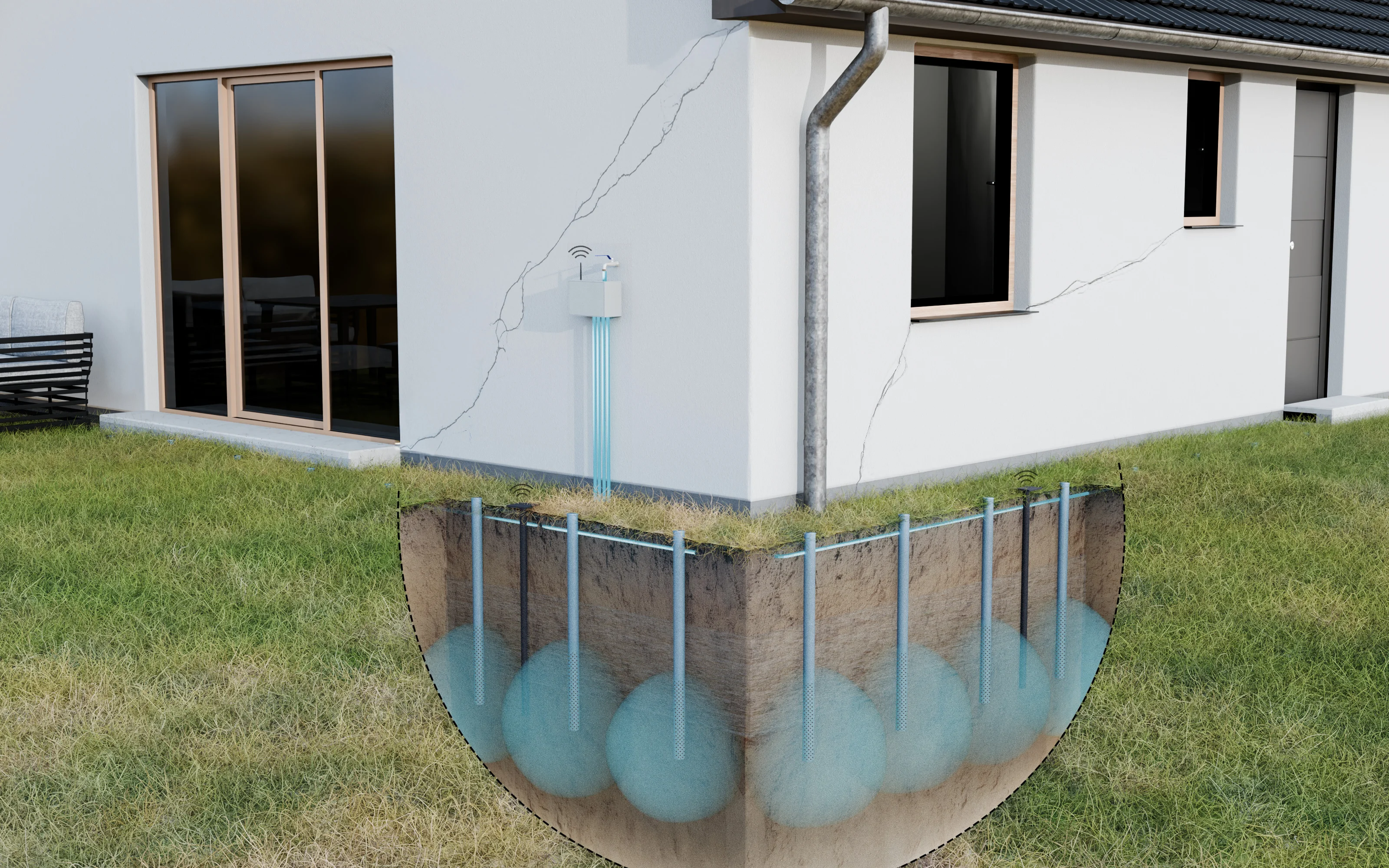
This type of system draws on precision agricultural irrigation technologies, adapted to the geotechnical context of buildings. Data collected over several seasonal cycles helps refine the algorithms and anticipate water needs based on weather forecasts.
How does TerraStab technology work?
TerraStab is the first commercial, accessible hydro-stabilization system designed to prevent the effects of clay shrink-swell subsidence around homes. It relies on established principles of unsaturated soil mechanics and applied hydro-geotechnical research.
In practice, TerraStab combines a network of connected sensors, a predictive model based on soil moisture and temperature variations, and automated shallow irrigation. The device continuously monitors the water status of the land, anticipates drying phases several days in advance, and maintains stabilized moisture around the foundations, thereby reducing the differential movement responsible for cracks.
- •Predictive hydro-geotechnical model: algorithm developed in collaboration with research labs, able to anticipate ground movement 7 to 15 days in advance by cross-referencing field data and weather forecasts [3]
- •Multi-parameter sensors: simultaneous measurement of volumetric moisture, temperature, and soil electrical conductivity for fine characterization
- •Adaptive control: automatic adjustment of water input based on soil type (plasticity, permeability), local climate, and variation history
- •Remote monitoring: telemetry and alerts in case of parameter drift, enabling preventive maintenance
In practice, the system operates in a closed loop:
- Sensors measure soil parameters every hour
- Data is transmitted to the controller, which applies the predictive model
- If water content drops below the stability threshold, irrigation activates automatically
- The system adjusts water input based on the soil's response (re-wetting speed, homogeneity)
- Historical data feeds the model's learning to improve accuracy over time
Typical use cases for TerraStab hydro-stabilization
The TerraStab solution — whether soil monitoring or full hydro-stabilization — addresses many common cases linked to clay shrink-swell subsidence, often more affordably and less invasively than micropiles.
- •Prevention in at-risk areas: For homeowners in low, medium or high hazard zones who want to anticipate clay movement. TerraStab monitoring tracks soil moisture continuously and prevents cracks from appearing, a major asset when buying a home or in case of doubt about the stability of the land.
- •Early-stage damage: Recommended for progressing fine cracks (0.2 to 3 mm) with no structural subsidence. TerraStab confirms whether water variations are the cause and, if needed, stabilizes the soil before damage worsens — a stage where micropiles are often premature and needlessly costly.
- •Economical alternative: For homeowners who cannot or do not want to undertake heavy underpinning (€35,000-€100,000). TerraStab is a significantly more accessible solution — several times cheaper than micropiles — non-invasive and quick to deploy.
- •Occupancy constraints: Ideal for continuously occupied homes (elderly people, families, difficult access). Unlike micropiles, which require noisy, dusty works and sometimes evacuating the home, TerraStab installation is clean, fast and doesn't disrupt daily life.
- •Complementary approach: After localized micropiles, TerraStab can monitor and stabilize the rest of the building, to prevent new cracks from appearing in unreinforced areas.
What are the advantages and limitations of water regulation?
Water regulation offers several advantages: no invasive works, lower cost compared to mechanical solutions, treating the cause rather than the symptoms, and compatibility with most building types. Its limitations include the need for a functional irrigation network, periodic sensor maintenance, and optimal effectiveness on moderately to highly clay-rich soils.
| Criterion | Water regulation | Micropiles |
|---|---|---|
| Works | Minimal (burying sensors and pipes) | Heavy (drilling, underpinning) |
| Installation time | 1 to 3 days | 2 to 6 weeks |
| Average cost | Affordable (€ out of 5) | Very high (€€€€€) |
| Maintenance | Annual (sensor check, filter cleaning) | None |
| Effectiveness | 85-90% movement reduction [1][4] | 95-100% (deeply anchored foundations) |
| Environmental impact | Low (controlled water use, reversible) | Medium (concrete, construction equipment) |
In practice, water regulation is particularly suited to the following situations:
- •Single-family homes on clay soil in medium-to-high hazard zones
- •Existing buildings with progressing cracks but no major structural damage
- •Prevention on recent constructions in at-risk areas
- •Budgets that don't allow for full underpinning
One of TerraStab's major goals is to make stabilization accessible to modest households. By reducing costs by 60 to 70% compared to micropiles and avoiding invasive works, the technology lets homeowners who couldn't afford underpinning protect their homes. This social dimension continues the legacy of public research: turning scientific advances into concrete, equitable solutions for everyone.
How to choose between water regulation and mechanical solutions?
The choice depends on several factors: severity of existing damage, available budget, foundation type, and hazard level. For active early-stage cracks and moderately clay-rich soil, water regulation is often sufficient and more economical. For major structural damage (large cracks, significant subsidence) or an older building with very shallow foundations, micropiles or underpinning may be necessary.
Decision criteria include:
- Building condition: fine, progressing cracks → water regulation; large cracks and deformation → mechanical solutions
- Soil type: moderately swelling clays → regulation; highly swelling clays + older building → combination of both approaches
- Budget: limited budget → water regulation as priority (much cheaper than micropiles); high budget → all options possible
- Urgency: prevention or early cracks → regulation; advanced damage → mechanical intervention
- Compatibility with the project: occupied home with no possibility of heavy works → water regulation
In some cases, a hybrid approach may be relevant: localized mechanical stabilization (for example under a particularly affected corner) combined with overall water regulation to prevent the damage from spreading.
Check your RGA risk
Find out if your home is exposed to clay shrink-swell subsidence and receive personalized recommendations.
Frequently asked questions
How much does hydro-stabilization cost?
The cost of a TerraStab system is significantly lower than traditional underpinning — around 3 to 6 times cheaper than micropiles [5]. It includes sensors, the controller, the irrigation network and installation, with minimal annual maintenance (sensor checks, filter cleaning). Ask for a personalized assessment for your configuration.
Is it compatible with all foundation types?
Yes, water regulation is compatible with most foundation types: strip footings, pad foundations, raft foundations. It's particularly effective on shallow foundations (less than 80 cm deep), the most exposed to RGA. For semi-deep or deep foundations, the benefit is smaller since deep soil is naturally more stable.
Can it be combined with existing solutions?
Absolutely. Water regulation can complement perimeter drainage, localized micropiles, or reinforced tie-beams. It can also be installed preventively after crack repair to avoid recurrence. This combined approach maximizes the durability of interventions.
What is the water consumption of such a system?
Consumption varies depending on climate, soil type and treated area. On average, a system regulates 10 to 30 liters per linear meter of foundation per month during dry periods, or 300 to 900 liters per month for a 100 sqm home. This consumption is optimized by sensors and predictive algorithms to provide only strictly necessary water [3].
Do insurers cover this type of solution?
Yes, as part of a Cat-Nat claim (natural disaster drought), insurers may cover all or part of stabilization works, whether mechanical or water-based. A preliminary geotechnical diagnosis and a detailed quote are generally required. Some insurers encourage preventive solutions and may offer premium reductions after installation [6].
In summary
Foundation stabilization on clay soils can be approached through two philosophies: working around the problem with heavy mechanical solutions, or treating the cause through water regulation. Innovations from public research, like TerraStab, open a complementary, less invasive and more accessible path, without sacrificing effectiveness. The choice depends on the building's condition, budget and risk level, and should always be guided by an in-depth geotechnical diagnosis.
References
[1] INRAE (2020). Clay soil stabilization through water regulation: experimental results. Applied geotechnical research program. https://www.inrae.fr
[2] Alternatives to micropiles for foundation stabilization in RGA zones. Applied geotechnical studies, 2021. georisques.gouv.fr
[3] TerraStab & INRAE (2022). Predictive modeling of clay soil water kinetics. Scientific publication, Journal of Geotechnical Engineering. https://www.terrastab.fr
[4] Evaluation of water regulation effectiveness at test sites (2020-2022). Experimental geotechnical studies, 2022.
[5] Comparative analysis of stabilization costs in RGA zones. Techno-economic study, 2021.
[6] FFA – French Insurance Federation (2020). Coverage of claims linked to clay shrink-swell subsidence. Practical Cat-Nat guide. https://www.ffa-assurance.fr