
A fuel-free trip around the world — and a question that changed everything
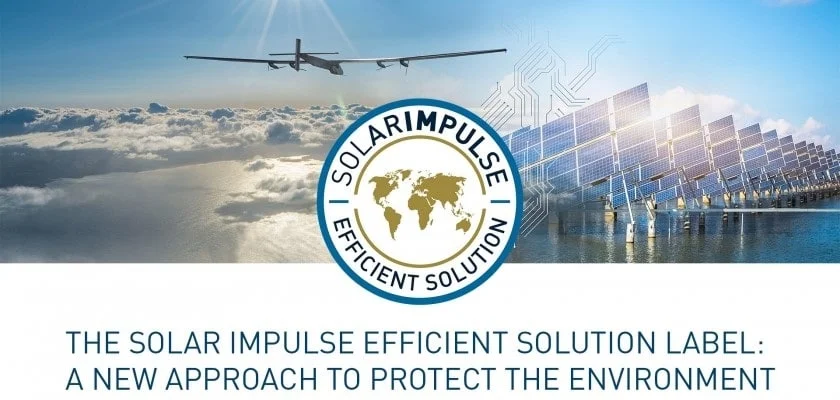
In 2016, Bertrand Piccard and André Borschberg achieved the impossible: flying around the Earth aboard Solar Impulse 2, an airplane powered solely by solar energy, without a single drop of fossil fuel. 40,000 kilometers. 17 legs. Zero emissions.
But beyond the technical feat, Bertrand Piccard drew a deep conviction from it: if a plane can fly around the world on clean energy, then profitable ecological solutions already exist — they simply need to be identified, recognized, and deployed at scale.
It is from this conviction that the Solar Impulse Foundation was born: to identify 1,000 solutions that prove ecology and economy are not at odds. Innovative, efficient, and accessible solutions — capable of changing practices on a global scale.
The "Efficient Solution" label: a demanding, worldwide certification
Earning the Solar Impulse Efficient Solution label is no formality. Every application is submitted to a committee of independent experts — engineers, economists, environmental specialists — who evaluate the solution against three strict criteria:
Technical feasibility — does the solution actually work, at scale, under real conditions? Environmental impact — does it measurably contribute to environmental protection or climate adaptation? Economic viability — is it profitable, accessible, and deployable without permanent subsidy?
The selection rate is high. Many applications are rejected. The foundation does not certify promises — it certifies solutions that have proven themselves.
What a solar plane and an anti-crack solution have in common
At first glance, what does an airplane flying around the Earth have to do with a solution protecting homes against clay shrink-swell subsidence?
The same fundamental bet: proving that clean, innovative technology can replace heavy, costly, destructive approaches.
Solar Impulse proved that a plane doesn't need kerosene to fly. TerraStab proves that a home doesn't need €50,000 micropiles to resist clay soil. In both cases, the solution was there — it just took the courage to engineer it and refuse to accept fatalism.
Clay shrink-swell subsidence (RGA) is the leading natural disaster in terms of cost in France — ahead of flooding. And yet the usual response remains partial demolition, underpinning work, six-figure repairs. TerraStab has developed a radically different alternative: acting on the cause, not the consequences.
TerraStab's innovation: regulating soil moisture to eliminate the problem at its source
Clay shrink-swell subsidence is caused by variations in soil moisture. In summer, the soil contracts. In winter, it swells. These repeated movements crack foundations and walls — progressively, over years, up to major structural damage.
TerraStab's solution rests on a simple but technologically advanced idea: keeping the soil within a stable moisture range year-round. To do this:
Buried connected sensors continuously measure water content at different depths. A predictive algorithm anticipates drought or saturation episodes. A subsurface irrigation system keeps the soil stable, with no masonry work required.
All for a cost starting from a few thousand euros — compared to €50,000 to €100,000 for underpinning work. A difference of scale that changes everything for homeowners.
It is precisely this model — innovative, measurable, economically accessible, and with strong environmental impact — that convinced the Solar Impulse Foundation's jury.
Why this recognition matters
The Solar Impulse label is recognized by governments, investors, and international institutions as a mark of seriousness and real impact. It confirms that TerraStab is not a marketing promise, but a solution validated by independent experts. It positions TerraStab among the global innovations driving the ecological transition in concrete, profitable ways. For homeowners: it's the guarantee that the chosen solution has passed a demanding international filter.
Is your home exposed to clay shrink-swell subsidence?
Get a free diagnosis in 2 minutes — directly from your smartphone or computer. Enter your address, get your RGA risk level, and find out if TerraStab can help you.