
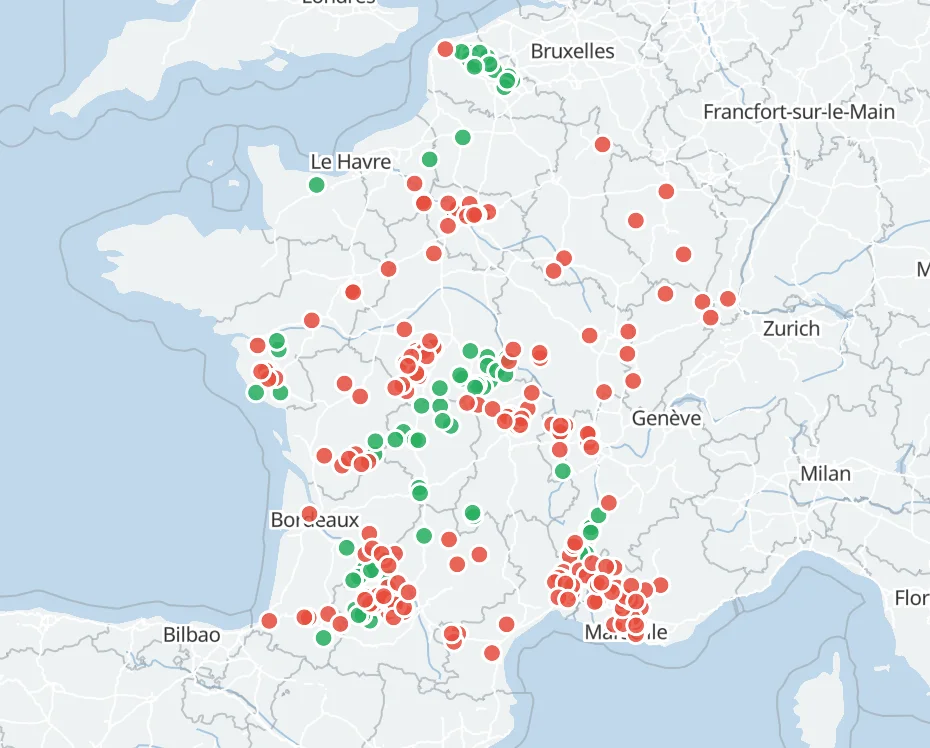
Key figures from June 12, 2026
107 municipalities recognized: natural disaster status granted for 2025 RGA. 2025: the claim year covered, from 01/01/2025 to 12/31/2025. 22 departments affected: Cher, Indre-et-Loire, Pas-de-Calais, Dordogne, Gironde, among others.
Cumulative 2026 figures: adding this order to the two previous ones (February 27: 72 recognized, March 13: 39 recognized), the total reaches 218 municipalities recognized since the start of 2026 for RGA alone — based on 2025 claims.
Center and North: the two hubs of this order
The June 12, 2026 order stands out for its dual geographic concentration. Centre-Val de Loire is the hardest hit: 25 municipalities in Cher and 20 in Indre-et-Loire obtain Cat-Nat recognition for RGA damage suffered in 2025.
More surprisingly: Pas-de-Calais ranks 3rd with 12 recognized municipalities — a territory not usually associated with RGA risk but which illustrates the nationwide spread of the 2025 drought.
Why so many municipalities in the Centre? The clay geology of Cher and Indre-et-Loire is among the most sensitive in France. In 2025, the drought there reached a return period of more than 10 years, satisfying the meteorological criterion required by the 2024 ministerial circular.
Recognized municipalities by department
The June 12, 2026 order covers RGA claims that occurred between January 1 and December 31, 2025. Here are the 107 recognized municipalities, by department:
Cher (18) — 25 municipalities: Ainay-le-Vieil, Apremont-sur-Allier, Augy-sur-Aubois, Beffes, Chalivoy-Milon, Charly, Farges-en-Septaine, Jussy-le-Chaudrier, Lantan, Loye-sur-Arnon, Marçais, Meillant, Montlouis, Neuvy-le-Barrois, Nozières, Ourouer-les-Bourdelins, Préveranges, Saint-Germain-des-Bois, Saint-Léger-le-Petit, Saint-Pierre-les-Bois, Sainte-Solange, Thaumiers, Torteron, Trouy, Vallenay.
Indre-et-Loire (37) — 20 municipalities: Artannes-sur-Indre, Azay-sur-Cher, Chambourg-sur-Indre, Chambray-lès-Tours, Civray-de-Touraine, Courçay, Cussay, Draché, Genillé, Joué-lès-Tours, Larçay, Loches, Louans, Manthelan, Montbazon, Saché, Sorigny, Thilouze, Truyes, Veigné.
Pas-de-Calais (62) — 12 municipalities: Belle-et-Houllefort, Beugin, Givenchy-lès-la-Bassée, Gonnehem, Hersin-Coupigny, Heuringhem, Houchin, Lapugnoy, Mont-Bernanchon, Richebourg, Robecq, Wingles.
Dordogne (24) — 11 municipalities: Bergerac, Castels et Bézenac, Cours-de-Pile, Creysse, Eyraud-Crempse-Maurens, Lamothe-Montravel, Mouleydier, Pontours, Sarlat-la-Canéda, Simeyrols, Thénac.
Gironde (33) — 6 municipalities: Bonnetan, Floirac, Saint-Caprais-de-Bordeaux, Saint-Maixant, Saint-Pierre-de-Mons, Saint-Selve.
Deux-Sèvres (79) — 5 municipalities: Cherveux, Luché-Thouarsais, Saint-Pardoux-Soutiers, Saint-Varent, Sainte-Verge.
Aisne (02) — 4 municipalities · Lot (46) — 3 · Lot-et-Garonne (47) — 3: Amigny-Rouy, Autreville, Beaumé, Noyales (Aisne) · Cressensac-Sarrazac, Cœur de Causse, Souillac (Lot) · Fieux, Nérac, Xaintrailles (Lot-et-Garonne).
Other departments — 1 to 2 municipalities each: Allier: Braize · Aveyron: Taussac · Cantal: Salins, Vernols · Corrèze: Brive-la-Gaillarde · Drôme: Étoile-sur-Rhône · Haute-Savoie: La Balme-de-Sillingy, Thyez · Haute-Vienne: Oradour-sur-Glane · Indre: Chasseneuil, Orsennes · Isère: Claix · Maine-et-Loire: Lys-Haut-Layon, Sèvremoine · Orne: Merlerault-le-Pin · Vendée: Notre-Dame-de-Monts.
What the 01/01/2025 – 12/31/2025 period means
Unlike previous orders that often covered targeted periods (summer or autumn), this one recognizes RGA damage over the entire year 2025. This reflects a drought that was not confined to summer, but affected clay soils over several consecutive seasons.
For affected homeowners, this means that all damage that appeared or was observed between January and December 2025 can potentially be covered by the Cat-Nat guarantee of their home insurance — provided their municipality appears on the official list.
Filing deadline: Homeowners have 30 days from the date of publication in the Official Gazette (June 13, 2026) to report their claim to their insurer, i.e. until July 13, 2026.
How to check if your municipality is recognized?
Several ways to find out if your municipality is included in the June 12, 2026 order:
1. Légifrance. The full text of the order (NOR: INTE2615534A) can be viewed on Légifrance (JORF No. 0137 of June 13, 2026). Annexes I (recognized municipalities) and II (denied municipalities) list all decisions.
2. Catnat.net. The official catnat.net website lists all recognitions by municipality since the first orders. Enter your INSEE code to find the full history.
3. Your town hall. The town hall is informed of decisions concerning it. It can confirm whether a request was filed and what outcome it received.
My municipality is recognized — what should I do now?
If your municipality appears in the June 12, 2026 order, here are the steps to follow immediately:
1. Report the claim to your insurer within 30 days of publication in the Official Gazette (i.e. before July 13, 2026). After this deadline, the Cat-Nat guarantee can no longer be activated for this order.
2. Document the damage: dated photos, a bailiff's report if possible, repair estimates. The stronger the file, the faster the compensation.
3. Request an expert assessment: the insurer will appoint an expert, but you can also bring in an independent expert, especially if the damage is significant.
4. Think about prevention: compensation repairs past damage, it does not protect against future claims. Without soil moisture stabilization, shrink-swell cycles will start again.
My municipality was denied — what should I do?
A denial does not mean your home is not exposed to RGA. It means the 2025 drought in your municipality did not reach the severity required by the 2024 circular (return period of more than 10 years). This could change with a future order if the drought intensifies.
Key point: A Cat-Nat denial does not exempt you from prevention. On the contrary, in a denied municipality, you cannot count on any insurance compensation in the event of RGA damage — which makes prevention even more urgent.
Check your actual exposure: the Géorisques map remains the official geotechnical risk reference. A municipality denied for Cat-Nat can perfectly well be classified as medium or high hazard on the RGA map. Contact your insurer: some policies include additional guarantees for structural RGA damage outside Cat-Nat. Check your terms and conditions. Administrative appeal: your municipality or a group of homeowners can challenge the denial before the administrative court within 2 months of publication.
Insurance alone is not enough
Even with Cat-Nat recognition, compensation only covers damage that appeared after the start date of the recognized period. Prior cracks and progressive damage remain your responsibility.
And above all: compensation does not fix the cause. If the clay soil under your foundations keeps drying out and rehydrating, new cracks will appear at the next drought.
TerraStab offers a system of connected sensors and underground irrigation that maintains a stable water content in the clay soil around your foundations — neutralizing shrink-swell movement before it causes new damage, without micropiles or heavy works.
Protect your home before the next order
Whether your municipality is recognized or denied, the RGA risk exists. A preventive solution protects you regardless of ministerial decisions.