
Spectacular vs systemic: two risks that have nothing in common
Philippe Isselin, CEO of TerraStab, put his finger on something essential in his latest LinkedIn article: there are two categories of climate risk that don't follow the same logic. Spectacular shocks — a storm, a hailstorm, a sudden flood — hit hard, make the news, then get absorbed. Insurers model them well. Homeowners remember them and take precautions.
Then there are the systemic drifts. Discreet, repetitive, growing. Clay shrink-swell subsidence belongs to this second category. No gust of wind, no sudden flood, no damage visible overnight. Just soil slowly shrinking under your home, summer after summer, drought after drought.
"A shock gets absorbed. A trajectory reshapes the models." The distinction applies as much to insurers as to homeowners: RGA cannot be fixed the way you fix a roof blown off by a storm.
What this distinction changes for you: a storm damages your home in one night. RGA degrades it over ten years, often below the threshold of perception — until the cracks become impossible to ignore and the solutions become unaffordable.
The numbers: a progression unlike any other
The data is now public and documented. For a long time, RGA weighed around €400 million a year on the natural disaster compensation scheme — a significant but stable and absorbable burden.
Starting in 2016, something changed. The frequency of prolonged summer droughts increased, and with it the intensity of ground movement. Between 2016 and 2020, the average annual cost of RGA more than doubled to around €1 billion a year. Then 2022 changed everything: that summer's exceptional drought alone generated €3.5 billion in RGA claims.
In short, the trajectory reads in three figures: around €400 million a year on average between 1989 and 2015, around €1 billion a year on average between 2016 and 2020, then €3.5 billion in a single year, 2022.
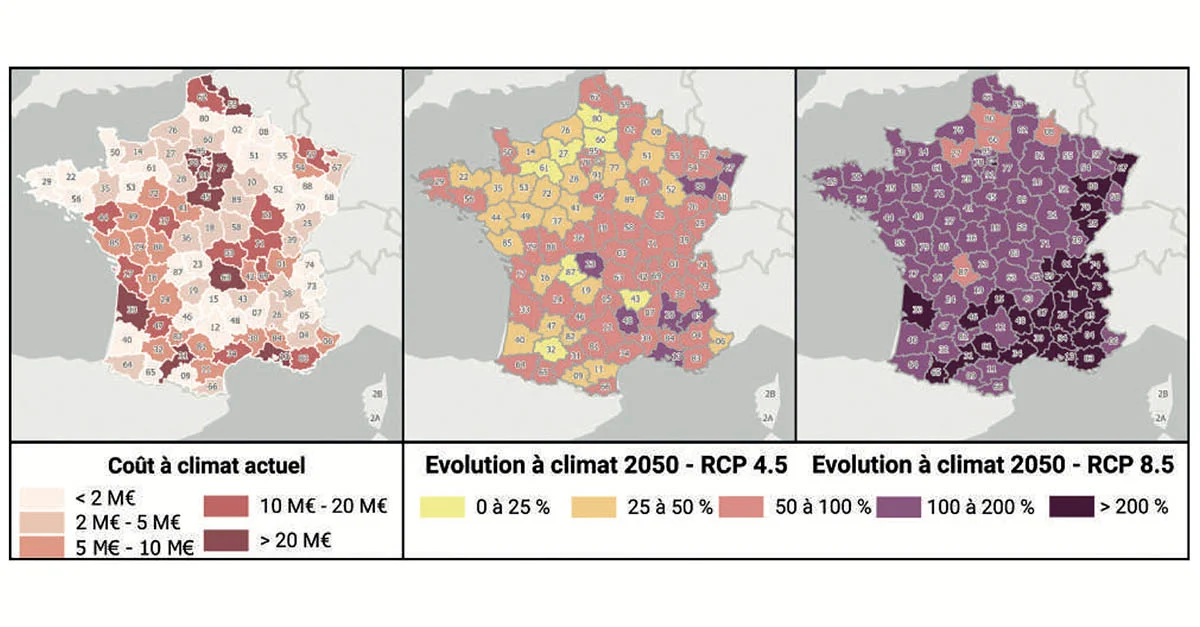
This isn't a statistical anomaly. It confirms a trend: since 2000, the cost of RGA has risen by +23%. And according to climate projections, RGA is now the peril with the strongest projected growth by 2050 among all natural risks.
Why this drift is different from flooding
Flooding is costly too. But its cost, while rising, remains more tied to the value of exposed properties than to a mechanical worsening of the phenomenon itself. RGA, on the other hand, worsens structurally: droughts are getting longer and more intense, meaning the soil shrinks more deeply and the shrink-swell cycles become more violent.
"When a billion becomes recurring, it's no longer a major disaster. It's a new normal." This phrase, used to describe the reality of RGA from insurers' point of view, applies just as much to your home: every summer drought leaves marks on the foundations. Those marks accumulate.
Floods hit hard and recede. Geotechnical drought — the technical term for RGA damage — settles in. Clay soil that has been through several successive droughts never quite returns to its original state. The damage is progressive and cumulative.
What this concretely changes for your home
The Cat-Nat (natural disaster) scheme, partly funded by a surcharge on all home insurance policies, will have to absorb this new reality. Premiums have already risen. They will keep rising.
But there's something more immediate: under the Élan law, any homeowner selling a property that has suffered a recognized Cat-Nat claim must disclose it to the buyer. If your home was compensated for RGA damage, this information appears in the sale file and can be negotiated down. In some highly exposed areas, RGA-related price discounts already reach 10 to 20% of the property's value.
Then there is the reality of the work involved. A superficial crack treated early costs a few hundred euros. A structural crack, a few thousand. Underpinning with micropiles: between €20,000 and €100,000. The cost isn't tied to the initial severity of the problem — it's tied to when you intervene.
The preventive window is closing. As long as the foundations are intact, a water-regulation solution remains accessible — far cheaper than micropiles or underpinning. Once structural damage sets in, that option no longer exists. Only repair remains.
What the 2022 figures imply is that hundreds of thousands of homeowners waited too long. They experienced an exceptional drought on soil already weakened by years of repeated cycles. Their home wasn't ready.
What you can do now
The first step is knowing your actual risk level. Not the generic risk for your municipality — official data is often too aggregated to be useful at the scale of an individual home. You need to cross-reference the exact address with national RGA data, soil type, and the characteristics of your construction.
If you're in a medium-to-high risk zone, the question isn't "will this happen to me?" but "when will it start becoming visible?" RGA damage is almost always already underway, even when you can't see it yet.
Acting before the first signs appear is the only way to stay within the preventive logic — and within the preventive budget.
What is your home's risk level?
Check for free in 30 seconds with our analysis tool based on 2026 national RGA data.