
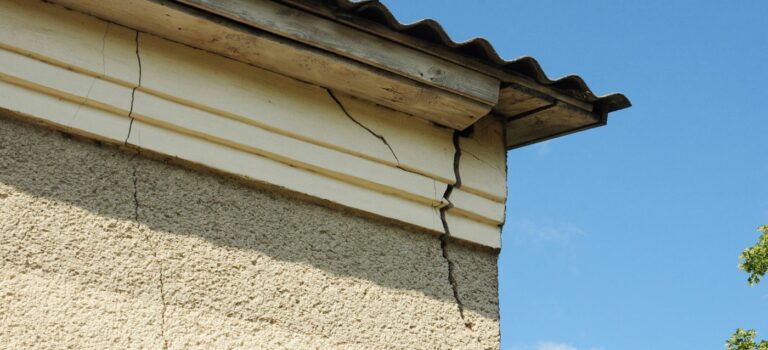
The homeowner paradox in the face of RGA
Human behavior toward risk is well documented: we prefer to do nothing as long as a problem isn't visible. This is especially true for RGA, whose damage accumulates over years before becoming alarming.
The result: the vast majority of foundation interventions linked to RGA are curative. We repair after. We spend heavily after. Whereas a preventive intervention, done at the right time, costs 10 to 20 times less.
According to data from the Caisse Centrale de Réassurance (CCR), the average cost of a compensated RGA claim is €18,000. An effective preventive solution is significantly cheaper — and can be put in place before the damage appears.
What underpinning really costs
Micropiles — the reference technique for underpinning foundations — involve heavy construction work. A drilling rig must access the inside of the house, break through slabs, drill down 15 to 20 meters to reach a stable geological layer, then pour reinforced concrete.
For a 100 m² home, micropiles cost between €20,000 and €60,000; for a home of 150 m² or more, the bill climbs to between €50,000 and €100,000. Expansive resin injection, a lighter alternative, costs €5,000 to €30,000. By comparison, a soil moisture regulation solution like TerraStab's remains far less costly than these underpinning techniques.
On top of this come indirect costs: temporary relocation during the works (2 to 6 weeks), restoration of drilled slabs and flooring, project management fees, and often unforeseen expenses linked to discovering the real condition of the existing foundations.
In the most severe cases, the total cost can exceed €100,000. And underpinning, however mechanically effective, does not prevent the continued deterioration of a structure that is already weakened.
What an effective preventive solution costs
RGA prevention rests on a simple principle: if the moisture level of clay soil stays stable throughout the year, the soil neither shrinks nor swells, and the foundations do not move.
Modern preventive solutions — such as TerraStab's connected soil moisture regulation — consist of installing moisture sensors in the ground and an automatic irrigation system that activates as soon as water content drops below a critical threshold.
A concrete example: a 120 m² home in a medium-risk area (Essonne, Gironde, Loiret...) can be equipped with a monitoring and regulation system at an affordable cost, installation included. Annual maintenance is minimal. Over 10 years, the total cost remains far below the threshold that triggers an average claim.
Why do homeowners wait so long?
Several psychological and practical mechanisms explain the inaction in the face of RGA risk.
The invisibility of the risk: unlike a flood, RGA damage accumulates slowly. The first cracks are often attributed to a house's 'normal settling' or to ordinary seasonal variations.
Present bias: investing in an affordable preventive solution today to avoid €50,000 in 5 years is mathematically obvious, but psychologically difficult. People prefer to postpone.
Lack of information: most homeowners have never heard of RGA when buying their property. Mandatory real-estate diagnostics don't always cover it explicitly enough.
The hope that 'it won't get worse': a crack that stabilizes during a wet winter can wrongly reassure homeowners. The cycle resumes as soon as the next drought hits, often more intensely.
The calculation that should change everything
Here is a simple comparison, applied to a 130 m² home in a medium-risk area, built on clay in the 1980s: doing nothing exposes the home to a claim within 8 years, with a repair cost between €35,000 and €80,000 and a loss of property value. Conversely, a preventive solution installed from year one has a much lower cost and keeps the foundations stable while preserving property value.
The conclusion is clear-cut. The question is not whether prevention is worth the cost — it always is. The question is whether to act now or wait until the problem becomes unavoidable.
Is your home exposed?
Check your RGA risk level for free in 30 seconds. An expert will contact you within 24h if needed.