
France, a more clay-rich country than people think
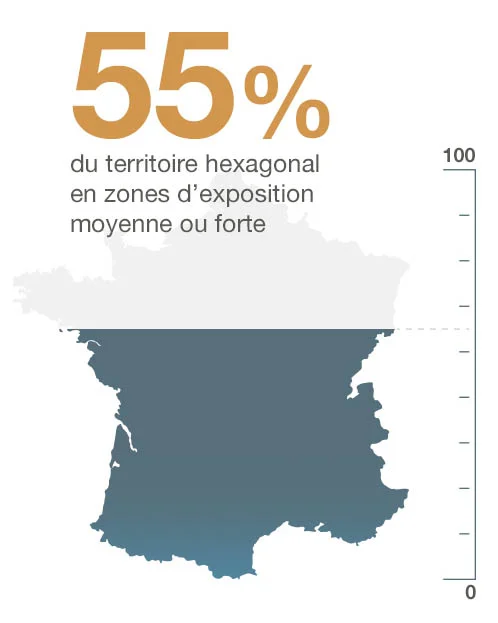
According to the official map available on Géorisques, 55% of mainland France is exposed to clay soils at a medium or high level. The sedimentary basins of central and southern France are particularly affected.
The most exposed regions — Centre-Val de Loire, Nouvelle-Aquitaine, Occitanie, Île-de-France — also concentrate some of the highest densities of single-family homes. This is no coincidence: clay is easy to build on at the surface, but unstable over the long term.
23.4 million single-family homes are exposed to RGA risk in France, according to 2026 national data. Of these, 12.1 million are in medium-to-high risk zones.
These figures remain largely unknown to homeowners, and even to many real estate professionals. The main reason: RGA is a slow, invisible, gradual risk — nothing like the sudden brutality of a flood or an earthquake.
The costliest natural disaster, the least well-known
Since 1989, clay shrink-swell subsidence has generated over 15 billion euros in damages compensated by insurers in France. It now accounts for 42% of the total cost of natural disasters — more than flooding, storms or hail combined.
Three figures sum up the scale of the phenomenon: 42% of the cost of natural disasters, over 15 billion euros in damages since 1989, and one home in two built on clay soil in France.
Yet when you ask homeowners in clay zones, the vast majority have never heard of RGA — or vaguely confuse it with earthquake risk. Institutional communication remains insufficient, and there are virtually no nationwide awareness campaigns.
The result: homeowners discover the problem once the first cracks appear. By then, it is often too late to act at low cost.
Climate acceleration changes everything
RGA is not a new phenomenon. What is changing is its intensity. The droughts of 2003, 2018, 2019 and 2022 caused exceptional ground movements, with record compensation payouts after each episode.
The mechanism is simple: during prolonged drought, clay loses its water and shrinks. Foundations anchored in this soil settle by anywhere from a few millimeters to several centimeters. Then, with the first significant rainfall, the soil swells back abruptly. These repeated cycles generate mechanical stresses that structures were never designed to absorb.
2050 projection: according to Météo-France, the frequency of summer droughts is expected to increase by 30 to 50% by 2050 in the southern half of France. Ground movements linked to RGA should intensify proportionally.
Areas currently classified as "low risk" could shift to "medium risk" within one or two decades. The 2019 RGA map, already more alarming than the 1994 one, will likely be revised upward again in the coming years.
What it actually costs homeowners
An untreated RGA claim develops in three phases. The first, superficial cracks, is often downplayed. The second, structural cracks (around openings, load-bearing walls), starts to affect the property's value. The third, partial collapse or the need for underpinning, costs between 20,000 and 100,000 euros.
On top of this come the indirect impacts: difficulty selling (the obligation to disclose past claims under the Élan law), rising or cancelled home insurance premiums, and a loss in property value that can reach 10 to 20% in the most exposed areas.
The paradox is cruel: a preventive solution like soil water regulation is far more affordable than structural repair — several times cheaper than underpinning or micropiles. But it must be put in place before the damage becomes irreversible.
What is the risk level of your home?
Check for free in 30 seconds with our analysis tool based on 2026 national RGA data.