
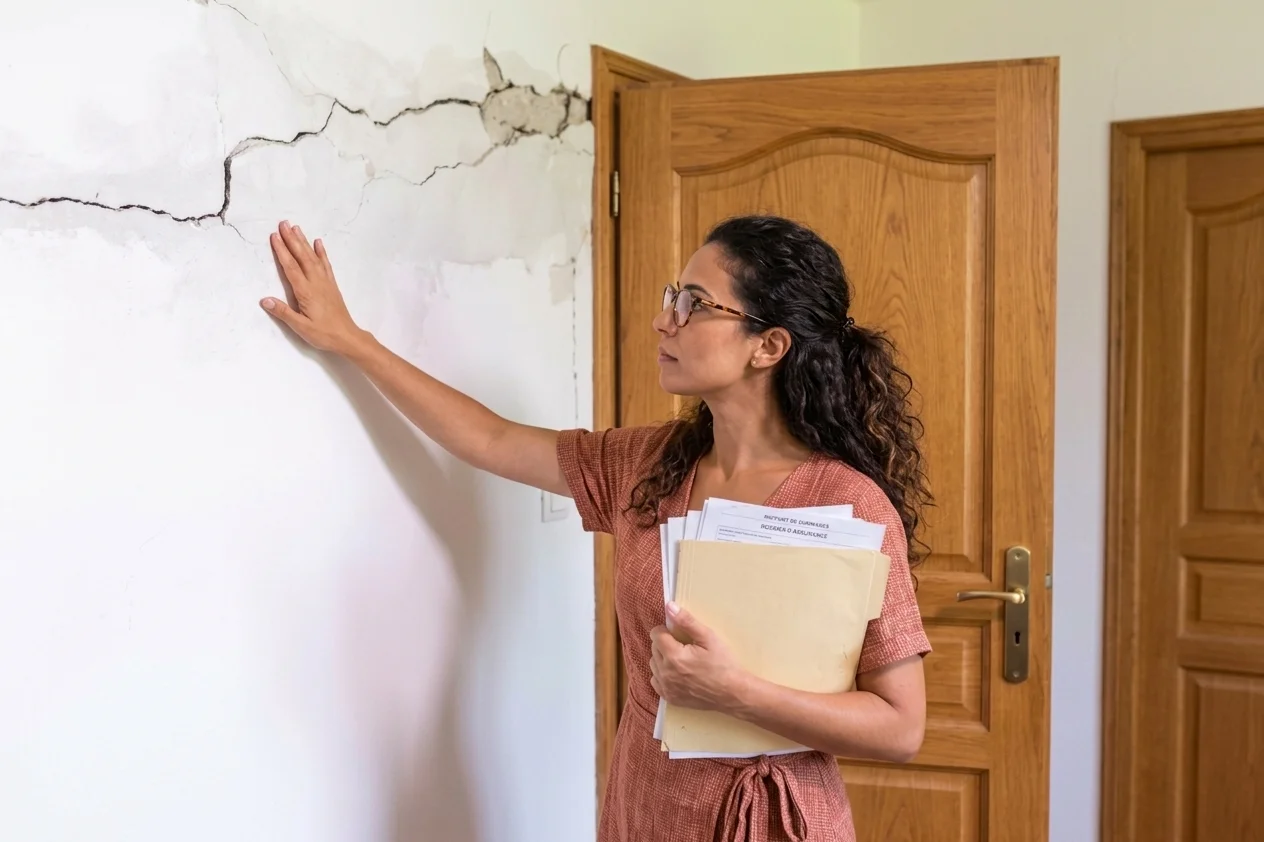
The double lock nobody explains to victims
Senator Christine Lavarde, in her 2023 information report on behalf of the French Senate's finance committee, put it with surgical precision: "Only 50% of towns manage to get a natural disaster (Cat-Nat) recognition, and only 50% of the claims filed in those towns receive compensation."
Nobody does this simple math for you. A hundred homeowners whose homes crack after a drought. Fifty live in a town that will get Cat-Nat recognition — the other fifty get nothing, even though their damage is identical. And of those fifty, only twenty-five will actually see their claim compensated.
The result: 75% of clay shrink-swell subsidence victims are left with no compensation whatsoever.
The natural disaster scheme is not a universal safety net. It is a double-filter system whose entry conditions have become increasingly restrictive.
The exclusion funnel: from claim to compensation
Of 100% of affected homeowners who file a claim, only 50% live in a town recognized as a natural disaster area. Of those recognized towns, 50% of claims are compensated — that is 25% of the original total. The result: 75% of clay shrink-swell subsidence victims receive no compensation at all.
(Source: French Senate information report, Christine Lavarde, finance committee, 2023)
How we got here: the story of a system closing in on itself
The Cat-Nat scheme was designed in 1982 on a simple principle: a mandatory surcharge on all home insurance policies, pooled across all policyholders, to cover exceptional natural disasters. At the time, clay shrink-swell subsidence was a marginal, little-known, rarely documented phenomenon.
Between 1995 and 2004, drought-related Cat-Nat recognition requests were granted almost systematically. The rejection rate was negligible. The system seemed generous.
Then droughts intensified. Claims exploded. In 2022 alone, the cost of drought-related claims reached 3.5 billion euros — a historic record. Faced with this surge, public authorities progressively tightened the criteria.
The 2024 circular codified this tightening: to obtain recognition, a town must now demonstrate a return period of more than 10 years on the soil moisture index. In plain terms: the drought episode must be statistically rare — in a France where severe droughts are becoming the norm.
In summary: 50% of towns obtain Cat-Nat recognition; 50% of claims are compensated in those towns; in the end, only 25% of victims receive any compensation.
The average cost of a drought claim: €24,000
Behind the overall statistics are families. According to the Caisse Centrale de Réassurance's 2024 report, the average cost of a drought claim is around 24,000 euros — twice the average cost of a flood claim.
This is a sum that changes everything. It is too small to trigger emergency public aid, too large to be absorbed by a median-income household without seriously affecting its finances. And for homeowners whose only asset is their primary residence — 80% of households exposed to RGA, according to the World Inequality Lab's research — this sum can represent several years of savings.
The 75% of victims left without compensation therefore face this reality alone: pay up, or live with the cracks.
"RGA victims are often invisible. People rarely talk about it, even though it's devastating for them. They are often people with little or no other assets besides their primary home." — Thomas Bézy, World Inequality Lab, Paris School of Economics
Why the trend will get worse, not better
The BRGM (French Geological Survey) has modeled climate trajectories. Its projections leave no room for doubt: a drought comparable to the one in 2003 — which triggered national awareness of the issue — could occur one year in three between 2020 and 2050, then one year in two between 2050 and 2080.
In this context, the tightening of Cat-Nat recognition criteria follows a perverse logic: the more droughts become the norm, the more they become statistically "non-exceptional," and therefore ineligible for recognition. The system, designed for rare hazards, is structurally unsuited to phenomena that have become recurrent.
The CCR admits as much in its own projections: the average annual cost of geotechnical drought will rise by +83% by 2050 from climate change alone, and by +103% when factoring in the growth of insured property. That is up to +€747M per year in additional costs. Figures that argue for a deep overhaul of the system — not a tightening of access.
What you can do — before the double lock closes on you
The 2023 reform stemming from the 3DS law slightly relaxed the criteria to better account for repeated and cumulative droughts. According to a specialist familiar with the file, applying it to 2022 data would have allowed "almost 20% more" recognitions. A real improvement — but one that doesn't change the fundamental equation.
The system's actual coverage rate remains far below what homeowners imagine. And there's no reason to expect a dramatic short-term improvement: the scheme's budget constraints are structural.
The only position that shields a homeowner in a clay area from this lottery is to act before the damage appears. A soil moisture regulation solution installed preventively costs between 2,000 and 8,000 euros. It protects foundations continuously — regardless of administrative decisions, the uncertainties of Cat-Nat recognition, and insurance assessments.
The double lock of the Cat-Nat scheme has no grip on a home whose foundations are stable.
Is your home in a risk area?
Check in 30 seconds with TerraStab's tool, based on official 2026 RGA data.