
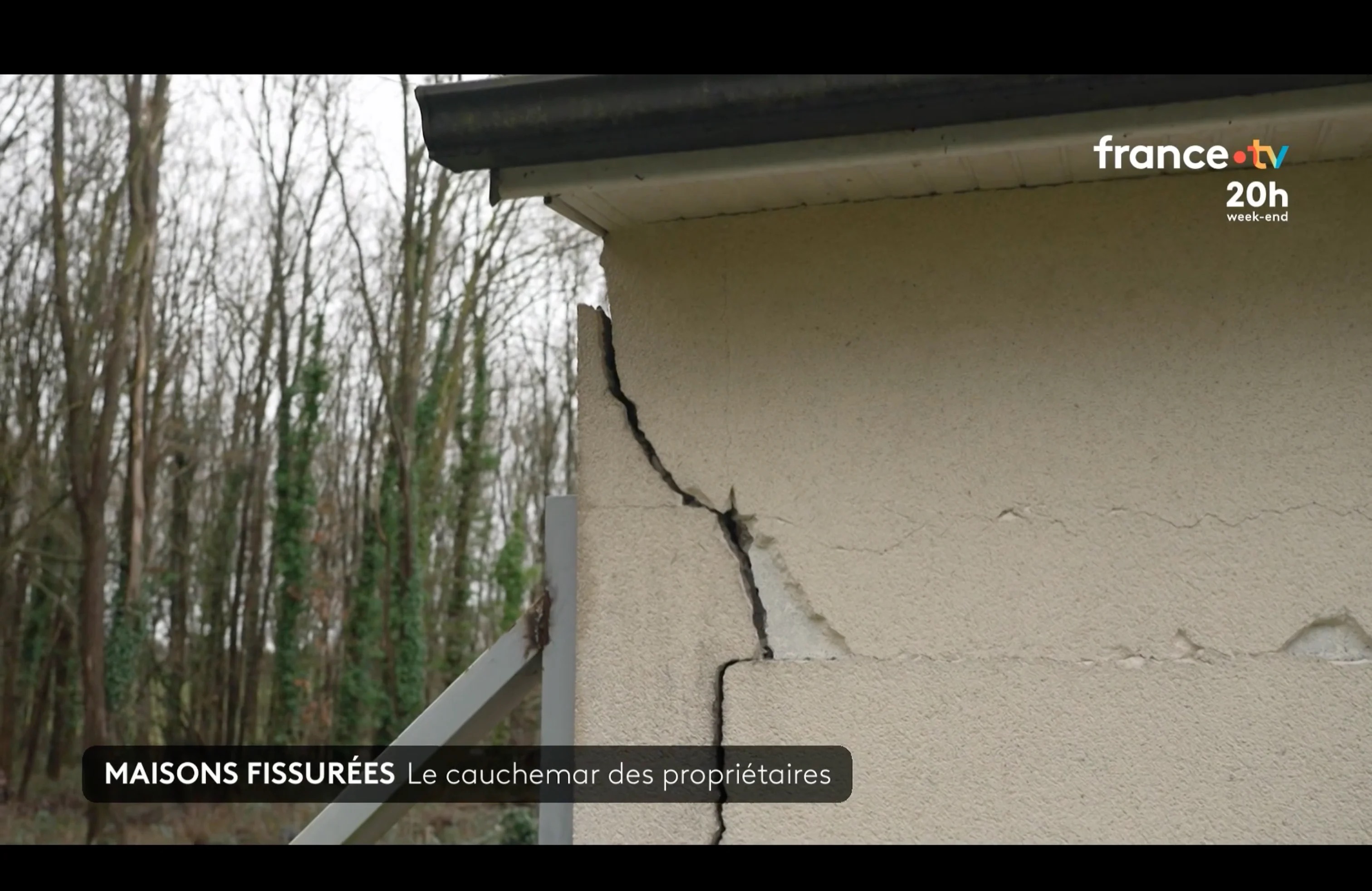
Clay shrink-swell subsidence regularly makes headlines
A recent France 2 TV report highlighted a reality that has become familiar to many homeowners: house cracks linked to clay shrink-swell subsidence. The footage is striking and useful for raising public awareness.
The images are striking. They show cracked facades, walls split open by several centimeters, and families facing sometimes very heavy damage. In some cases, repairs can reach considerable amounts.
These accounts matter, as they help raise public awareness of a phenomenon affecting several million homes in France. But as is often the case with general-interest TV formats, the technical reality of the phenomenon is simplified.
Real footage… but a partial view of the problem
In the report, the solutions mentioned mainly involve heavy repairs: resin injection or foundation underpinning with micropiles. These techniques exist and are sometimes necessary, particularly when the damage is already advanced.
The construction footage shows the scale of these interventions: excavation around the house, heavy machinery, metal support structures installed under the foundations. In some cases, the work can resemble a partial reconstruction of the home.
However, this presentation gives the impression that these solutions are the only possible response to house cracks. The reality is more nuanced. Not every situation requires such heavy work.
Cat-Nat: a system more complex than it appears
The report also mentions the role of the Cat-Nat (natural disaster) scheme in compensating homeowners. The sequence may give the impression that once a municipality is declared a natural disaster area, insurers automatically cover the repairs. In practice, the situation is often more complex.
Natural disaster recognition unfolds in several steps. Each claim must be examined individually. The insurer must recognize the link between the damage and the climate event. In some cases, compensation may be partial or disputed.
When repairs exceed several tens of thousands of euros, this difference can represent a major financial issue for homeowners.
The real driver of the phenomenon: drought
Clay shrink-swell subsidence is often mentioned in the news during episodes of flooding or heavy rain. Yet the phenomenon mainly originates during periods of drought.
When clay soil dries out, it loses water and shrinks. This movement can cause localized ground subsidence beneath the house foundations. The walls, which rest on these foundations, are then subjected to mechanical stress that can lead to cracks.
This is precisely why Cat-Nat orders related to clay shrink-swell subsidence are linked to drought episodes, not flooding.
An asymmetric physical phenomenon
We often talk about clay "shrink-swell," which might suggest the two movements are equivalent. In reality, they are not.
The shrinkage of clay, caused by drought, is generally faster and more pronounced than the swelling that can follow when moisture returns. The weight of the house also plays an important role. As the soil shrinks, the building structure presses down on the ground and can accentuate the deformations.
Conversely, when the clay rehydrates, the weight of the house often limits the ability of the soil to fully regain its original volume. In many cases, the observed swelling corresponds more to a partial recovery of the original volume than to true expansion.
Not every situation requires heavy work
Micropiles or foundation underpinning are sometimes essential when structural damage is already significant. But there are also intermediate approaches aimed at stabilizing soil behavior.
The report also gives a voice to Mr. Benyahia, president of the Association Urgence Maison Fissurée (AUMF), which represents homeowners affected by this phenomenon.
These solutions rely in particular on better management of clay moisture and on techniques to limit water fluctuations around the foundations. The goal is to act on the cause of the phenomenon rather than only addressing its consequences.
Understanding the phenomenon to better protect homes
With the changing climate and intensifying drought episodes, clay shrink-swell subsidence is becoming a growing issue for buildings in France. Better understanding the mechanism helps identify the most exposed homes and consider solutions adapted to each situation.
Between diagnosis, prevention, and technical interventions, the topic of house cracks linked to clay soils deserves a more thorough approach than the one usually allowed by short news formats.
What is your home's risk level?
Check for free in 30 seconds with our analysis tool based on official 2026 national RGA data.