
A disaster that keeps repeating is no longer a disaster
The word 'disaster' implies the exceptional, the unpredictable — a rare event that justifies an emergency collective response. That is the logic on which the Cat-Nat scheme was built: a national solidarity mechanism for hazards nobody can anticipate.
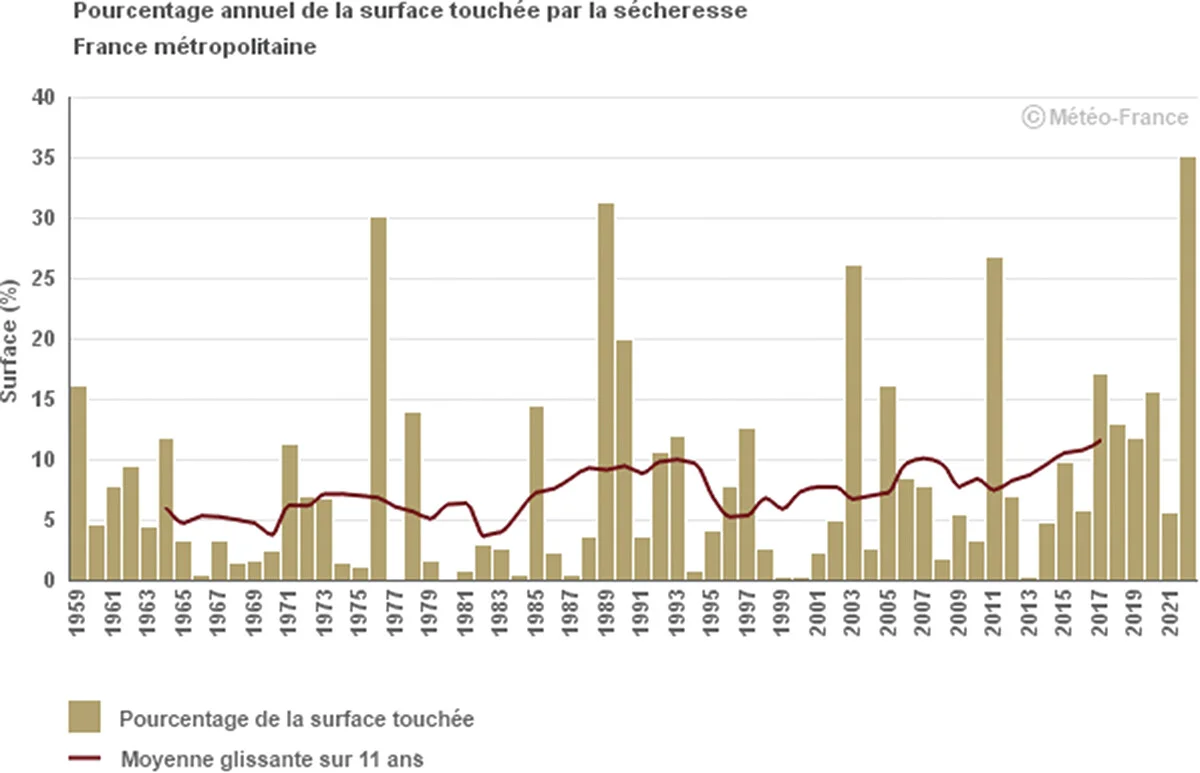
But clay shrink-swell subsidence (RGA) doesn't work that way. The droughts of 2003, 2018, 2019, 2022, and 2025 have followed one another at a pace that is no longer exceptional at all. And each time, the same municipalities, the same clay soils, the same homes — the same cracks. When a risk recurs regularly and predictably, it has changed in nature. It is no longer a hazard. It is a structural fact.
A risk that materializes regularly is not a risk to insure against. It is a risk to prevent.
The recognition of Marseillan for the 2025 drought is therefore not, strictly speaking, bad news. It is a signal — the signal that in this area, as in thousands of others across France, clay soil has become a permanent source of instability for home foundations.
Three million homes in a zone of certainty, not uncertainty
In France, more than 3 million single-family homes are exposed to clay shrink-swell subsidence. RGA accounts for 70% of total Cat-Nat compensation costs over the past five years — the 2022 drought alone cost €3.5 billion.
These figures don't describe a hypothetical risk. They describe a trajectory. As summer droughts intensify, the clay-rich areas of southern and central France and the Paris basin are no longer asking whether they will be affected — only when, and how severely.
Property value is a different question when the risk is certain rather than merely probable. Homeowners cannot indefinitely hope to be among the recognized municipalities, wait for the insurer's payout, and start the cycle over at the next episode. That cycle has a financial cost, a psychological cost — and above all, it solves nothing.
Protecting property value once the risk is a given
There is a simple logic that is often overlooked: you don't insure what is certain, you prevent it. Nobody takes out fire insurance hoping the house will burn down — they install smoke detectors and secure the wiring. The same reasoning applies to the soil beneath the foundations.
In areas where drought-rehydration cycles have become the norm, the relevant question isn't 'will I be compensated if my walls crack?' It's 'how do I make sure my walls don't crack in the first place?'
Actively regulating soil moisture around the foundations — before the drought episode, not after — means acting on the cause, not the consequence. It also preserves property value: a home that has never suffered an RGA claim sells better, insures more easily, and carries no damage history that the law now requires sellers to disclose.
The real property question: in an area where drought returns every summer, a home without active foundation protection is a home whose value erodes with every cycle — silently, but surely.
The right time to act is before
Hérault is one of the departments most frequently cited in successive Cat-Nat decrees. That is no geological coincidence — it is the result of clay soil, a destabilizing climate, and homes built without this factor being properly anticipated.
For affected homeowners, each additional Cat-Nat recognition should serve as a warning signal — not to claim compensation, but to understand that the next episode is already scheduled by the climate, and that the interval between the two is the only useful window to act.
A home protected before the next drought will not be one more statistic in the next Cat-Nat decree. It will simply be a home that did not move.
Is your home built on clay soil?
Check your exposure level in 30 seconds with our tool, based on official national data.