
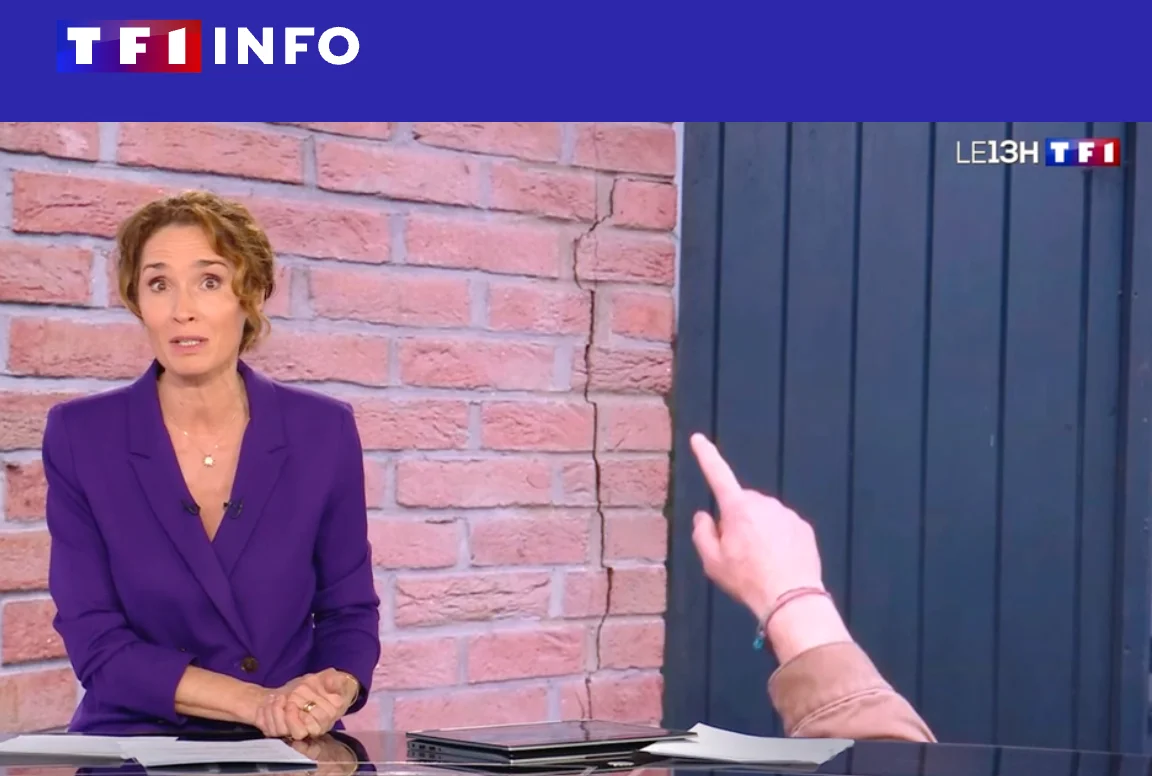
The government on air twice in one day: RGA is no longer a niche topic
Coverage at noon, another at primetime, on France's leading news channel: this is no trivial choice. When the same topic comes back twice in a single day on TF1, it means a political message is trying to take hold in public opinion. Clay shrink-swell subsidence, long confined to local news and technical reports, is now entering the mainstream media agenda.
This shift in media coverage follows a heavy trend: RGA insurance costs have been multiplied by eight in thirty years, and the government is now trying to explain to the French public that a new collective undertaking is beginning. The tools put in place still need to deliver on their promises.
The numbers: 2,000 applications, 19 processed
Launched in September 2025 across 11 pilot départements, the pilot scheme was meant to fund diagnostics and preventive works for exposed homeowners. Six months later, the Minister for Ecological Transition himself admits a success that is "mixed at best." Here are the raw figures presented in the report.
Of the 2,000 applications filed by homeowners, only 218 were deemed eligible after the criteria filter. In the end, only 19 applications were processed — less than 1% of applicants ultimately helped.
€30 million in public funding. 19 cases ultimately processed. On paper, the budget is generous. In practice, the overwhelming majority of homeowners who had the courage to file an application were left behind.
The report puts a face on these statistics. Solveig, in the Sarthe region, counts around a hundred cracks on her home's walls. Vertical, horizontal, fissures accumulating "relentlessly" across every facade. Her conclusion is blunt: her house is "terribly devalued." How many Solveigs are among the 1,800 rejected applications?
Why 99% of applicants are rejected: criteria cut too fine
The report lists the scheme's initial eligibility conditions:
Crack width under 1 millimeter. Yet structural cracks linked to RGA almost always exceed this threshold. For most homeowners, by the time they seek help, they already have clearly visible cracks — not cosmetic hairlines. Homes limited to a maximum of two levels, basement included. This immediately excludes a very large share of the French housing stock. Restrictive income conditions and an out-of-pocket cost deemed prohibitive for eligible households.
The head of a homeowner victims' association sums it up bluntly in the report: "It's hard to imagine people panicking over a tiny crack when they're dealing with everyday problems — putting gas in the car, feeding their kids — and suddenly they're going to drop everything and apply to this scheme."
The scheme's central paradox: it was calibrated to address damage that should have been prevented in the first place. At 1mm of crack width, the foundations have already moved. At 5mm, it's more visible — but the ground movement that caused it is intact and will resume with the next drought.
The announced relaxation: 5mm and 3 levels — what does it change?
Faced with this evident failure, the government is "shifting gears" and announced this week a relaxation of the criteria:
Maximum crack width raised from 1mm to 5mm. Homes with three levels now admitted.
This is progress. Mechanically, the pool of potential applicants will widen. But it doesn't address the heart of the problem: the scheme remains curative, stepping in once the damage is already done, and it continues to leave a significant out-of-pocket cost for the most modest households.
Above all, even though the aid funds repair works, it doesn't address the cause: the clay soil will keep shrinking with the next drought. The minister himself half-admits it — the RGA cost trajectory, multiplied by eight in thirty years, cannot be contained by a curative scheme alone.
The blind spot in these reports: acting before the crack appears
As Solveig explains in the report, the mechanism is well known: "The soil shrinks when it's dry and swells back with the rains." This cycle is what weakens foundations. With global warming, these phenomena are intensifying — what used to be an occasional hazard is becoming a recurring certainty for millions of homeowners.
This is precisely the angle missing from the coverage: it's all about repair aid, never about prevention. Yet acting before the crack appears costs a fraction of the price of underpinning work — and avoids both the human toll and the loss of property value.
This is the approach TerraStab offers: maintaining stable soil moisture through connected sensors and a subsurface irrigation system. Shrink-swell cycles are limited, foundations stop moving, and cracks don't appear. To understand the mechanism, see our guide Understanding clay shrink-swell subsidence.
Key takeaways
TF1 covered RGA at noon AND at primetime on May 13, 2026 — the government is actively pushing the topic. Review of the aid scheme: 2,000 applications filed, 218 eligible, 19 processed — less than 1%. The relaxation (1 → 5mm, 2 → 3 levels) widens the pool but doesn't change the curative logic. The only rational response to a risk that has become structural: prevent before the cracks appear.
Is your home exposed?
Check for free in 30 seconds with our analysis tool based on official national RGA data.