
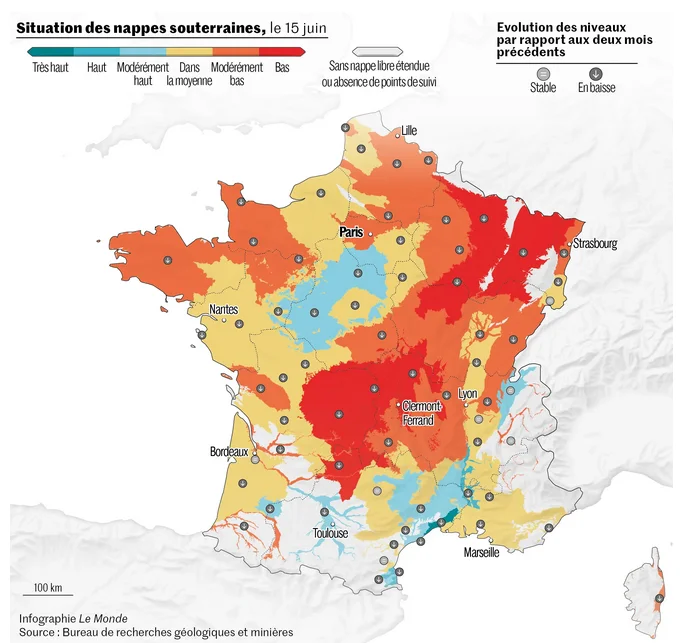
What Le Monde reports: a summer 2026 under water stress
France's soil moisture indices as of late June 2026 show that the driest areas correspond to the territories most exposed to clay shrink-swell subsidence.
The Garonne river is experiencing its first hydroelectric dam releases in thirty-three years at such an early date. In June, France received an average of 27mm of rainfall — against a normal of 68mm for the month. Soils are showing record moisture indices in several regions: Alsace, Aquitaine, Centre.
The BRGM anticipates "mostly declining" trends for groundwater tables in the coming weeks. Seventy-eight préfectures have already introduced water restrictions or conservation incentives. In the Allier département, irrigating crops by drawing water from rivers has been banned since June 23.
This climate picture is concerning for many reasons. For homeowners in clay areas, there's one more — often overlooked.
The direct link with clay shrink-swell subsidence
Clay shrink-swell subsidence is caused by variations in soil moisture. When drought sets in, clay contracts. House foundations, resting on this unstable soil, undergo differential movement — and cracks appear, first diagonally on walls, then around door and window frames, then on flooring.
This phenomenon now accounts for 43% of the total cost of natural disasters in France since 1989, ahead of flooding. And unlike flooding, it worsens silently — damage accumulates over years, often without the homeowner making the connection.
An early, prolonged drought like the one unfolding in 2026 is precisely the worst-case scenario: the soil dries out deeply, clay contracts across large depths, and foundation movements are amplified.
What the BRGM says about clay soils
12.1 million homes are classified in medium or high RGA hazard zones in France. 55% of the territory is now classified at risk in the 2026 mapping. The soil moisture indices used by the BRGM to predict RGA are exactly the ones reaching record levels this summer.
"But using water to protect my home, during a restriction period..."
It's the question everyone asks — and it's a fair one. If the TerraStab solution relies on maintaining soil moisture, doesn't it use water precisely when water is scarce?
The answer is no — or almost. Here's why.
To stabilize the clay around a home over a four-to-six-month drought season, the TerraStab system uses the equivalent of a 4-to-6-minute shower per day. That's it.
To put this figure in perspective: a French person uses on average 148 liters of water per day for domestic use — 39% of it for toilets alone, 25% for personal hygiene, 20% for laundry and dishes. Soil moisture regulation represents a marginal fraction of this consumption. It's incomparable to agricultural irrigation, which accounts for over 80% of total water consumption in France.
In other words: protecting your home against RGA does not "steal" water from rivers or aquifers. The impact is negligible at the watershed scale — while the benefits are structural.
In figures: ~30 L/day for TerraStab's soil moisture regulation during a drought, versus 148 L/day for the average French person's domestic consumption, and agricultural irrigation consuming up to ×5,000 times more.
Tomorrow: zero water from the mains
TerraStab is currently working on a complementary solution that directly addresses this question: a rainwater harvesting system coupled with soil moisture regulation. The idea is simple: store abundant winter rainfall to use in summer, when the clay needs it.
This solution isn't commercially available yet, but it illustrates TerraStab's underlying logic: working with natural cycles rather than against them. A rainy winter — like that of 2026 — becomes a resource for getting through the dry summer.
This is also what Le Monde points to: the sharpening contrast between winter and summer seasons is a deep trend linked to global warming. Rainwater harvesting is a direct response to this polarization.
What this concretely means if your home is in a clay area
If your home is classified in medium or high RGA hazard, a summer like this one is a signal. Not an absolute emergency — shrink-swell subsidence acts over years — but a reminder that every drought accelerates the process.
Watch for new diagonal cracks appearing on interior and exterior walls — they're the first visible signal. Avoid planting trees or hedges within 10 meters of the house — roots draw moisture from the soil and worsen shrinkage. If you already have existing cracks, photograph them regularly with a ruler to track their progression. Check your RGA risk level — 55% of the territory is now classified, and many homeowners are unaware of it.
Is your home in a clay area?
Enter your address and get your RGA risk level in 2 minutes — official BRGM data.